eROSITA 叠加说银河系质量星系有 10–50 kpc 的热 CGM,我们的 XMM 分辨测量低约 5 倍——先别问谁对,先问仪器造了多少eROSITA stacks find hot CGM at 10–50 kpc around Milky-Way-mass galaxies; our resolved XMM measurements are about 5 times lower — before asking who is right, ask how much the instrument makes
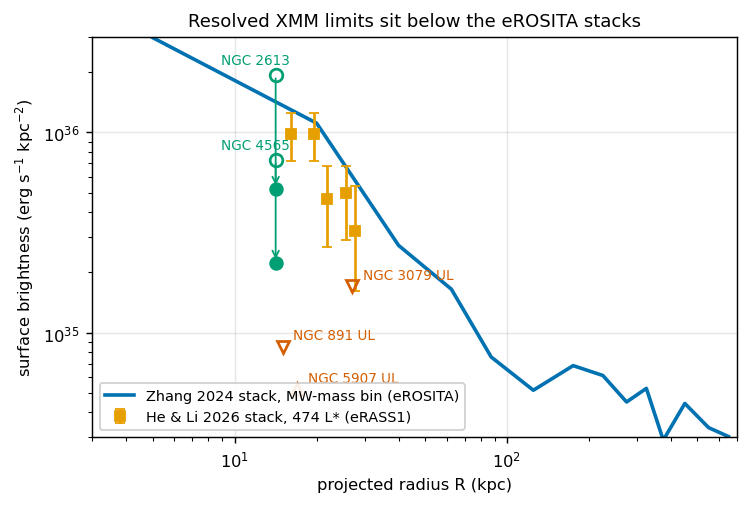
横轴投影半径(kpc),纵轴面亮度(erg s\(^{-1}\) kpc\(^{-2}\)),双对数。蓝线 Zhang 2024 银河质量档叠加;橙方块 He & Li 2026 的 474 颗 L* 叠加;空心符号是邻近旋涡的 XMM 上限,绿箭头是档案预报值。x: projected radius (kpc); y: surface brightness (erg s\(^{-1}\) kpc\(^{-2}\)); log–log. Blue: the Zhang 2024 Milky-Way-mass stack; orange squares: the He & Li 2026 stack of 474 L* galaxies; open symbols are XMM upper limits for nearby spirals; green arrows are archival forecasts.
两条证据差约 5 倍。今天的报告不讲谁对,讲一件必须先做的事。Two evidence lines differ by about a factor of 5. Today is not about who is right; it is about what must be done first.
45 分钟后你会知道:XMM 仪器在目标位置制造多少信号,以及为什么档案叠加必须逐场减零值。In 45 minutes you will know how much signal the XMM instrument makes at the target position, and why archival stacks must subtract nulls field by field.
图:handbook scripts/make_figures.py fig_tension.png;数据来源见文末来源标记Figure: handbook scripts/make_figures.py fig_tension.png; data sources in the source markers at the end
2
结论 2:pn 的零信号偏置为零,而 MOS 的偏置是负的、随场而变——两个硬超额场甚至翻正Message 2: the pn null offset is zero, but the MOS offset is negative and field-dependent — the two hard-excess fields even flip sign
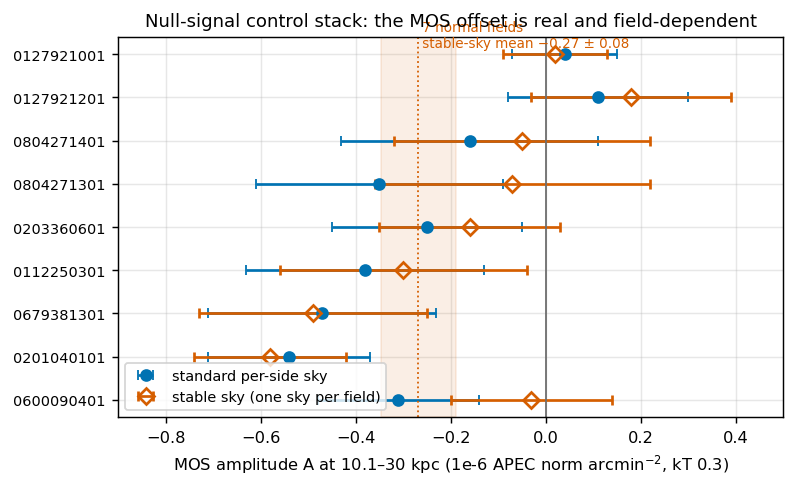
每行一个零场;横轴 MOS 幅度 \(A\)(10.1–30 kpc)。蓝圆=标准(每侧一天空),红菱形=稳定天空(一场一天空)。红带是 7 个常规场的稳定天空均值 \(-0.27 \pm 0.08\)。最后两行是硬超额控制场。One row per null field; x: MOS amplitude \(A\) (10.1–30 kpc). Blue circles = standard (one sky per side); red diamonds = stable sky (one sky per field). The red band is the 7-normal-field stable-sky mean \(-0.27 \pm 0.08\). The last two rows are the hard-excess controls.
7 个常规场 \(-0.37 \pm 0.08\),2 个硬超额场 \(+0.06 \pm 0.10\):两组差 \(0.43 \pm 0.12\)(\(3.4\sigma\))。7 normal fields \(-0.37 \pm 0.08\), 2 hard-excess fields \(+0.06 \pm 0.10\): the groups differ by \(0.43 \pm 0.12\) (\(3.4\sigma\)).
图:handbook scripts/make_figures.py fig_nulls.png;数据 null_pilot/fits/results_claude/Figure: handbook scripts/make_figures.py fig_nulls.png; data null_pilot/fits/results_claude/
8
没有天空范型、硬波段 QPB 或 CCD 组合能预测这个偏置——但天空在必须稳定的地方不稳定No sky norm, hard-band QPB or CCD set predicts the offset — yet the sky is not stable where it must be
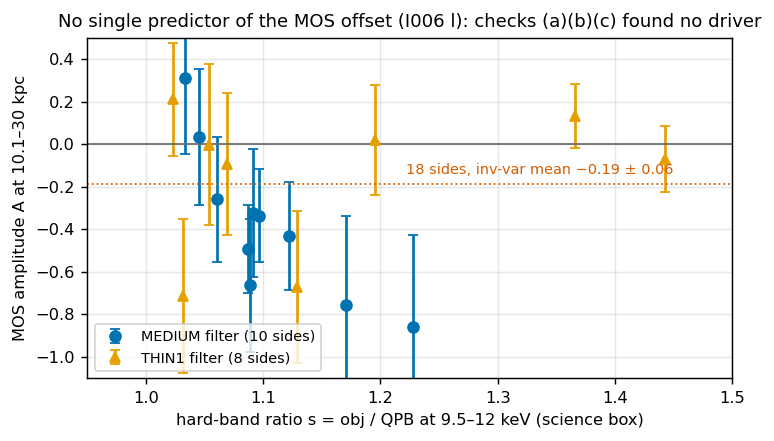
横轴硬波段比 \(s =\) 科学框计数 / QPB 模型(9.5–12 keV),纵轴 MOS 幅度 \(A\)。蓝圆=MEDIUM 滤光片,橙三角=THIN1。红线是 18 场侧的反方差均值 \(-0.19 \pm 0.06\)。x: hard-band ratio \(s =\) science-box counts / QPB model (9.5–12 keV); y: MOS amplitude \(A\). Blue circles = MEDIUM filter, orange triangles = THIN1. The red line is the 18-side inverse-variance mean \(-0.19 \pm 0.06\).
19 个预测量里没有一个达到 \(2.2\sigma\);但同一场的 N/S 参照框给出不同天空(LHB 差 \(100\times\)),四个 NGC 5746 历元给出 CXB 从 0 到 \(3.8 \times 10^{-7}\)。Of 19 candidate predictors none reaches \(2.2\sigma\); yet the N and S reference boxes of one field give different skies (LHB differs by \(100\times\)), and the four NGC 5746 epochs give CXB from 0 to \(3.8 \times 10^{-7}\).
图:handbook scripts/make_figures.py fig_qpb.png;数据 null_pilot/fits/results_claude/Figure: handbook scripts/make_figures.py fig_qpb.png; data null_pilot/fits/results_claude/
10
可跳过:同一物理的三种仪器几何——为什么 eROSITA 叠加远星系而 XMM 看近星系Skippable: the same physics through three instrument geometries — why eROSITA stacks distant galaxies and XMM sees nearby ones
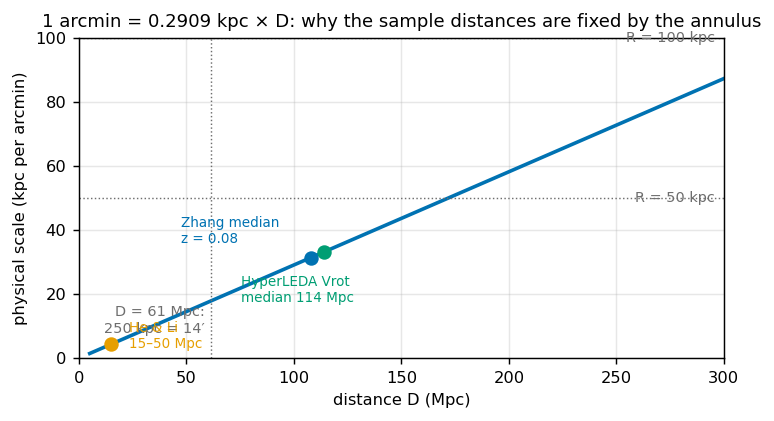
横轴距离(Mpc),纵轴 1 角分对应的物理尺度(kpc)。竖虚线:250 kpc 恰好填满 XMM 14′ 可用视场的距离(61 Mpc)。三个点:He & Li 样本、Zhang 中位红移、HyperLEDA Vrot 中位距离。x: distance (Mpc); y: physical scale of 1 arcmin (kpc). Vertical dotted line: the distance where a 250 kpc radius fills the XMM 14′ usable field (61 Mpc). Points: the He & Li sample, the Zhang median redshift, the HyperLEDA Vrot median distance.
远星系把整个晕装进小视场(叠加可行),近星系装不下(须逐星分辨)——这是两套方法各有所长的几何根源。Distant galaxies fit the whole halo into a small field (stacking works); nearby ones do not (resolve each galaxy) — the geometric root of why the two methods each have their place.
图:handbook scripts/make_figures.py fig_kpc_per_arcmin.pngFigure: handbook scripts/make_figures.py fig_kpc_per_arcmin.png
16
可跳过:叠加的信噪比按 \(\sqrt{N}\) 增长——但系统误差不随 \(N\) 缩小,这正是本工作的动机Skippable: the stack S/N grows as \(\sqrt{N}\) — but systematics do not shrink with \(N\), which is exactly why this work exists
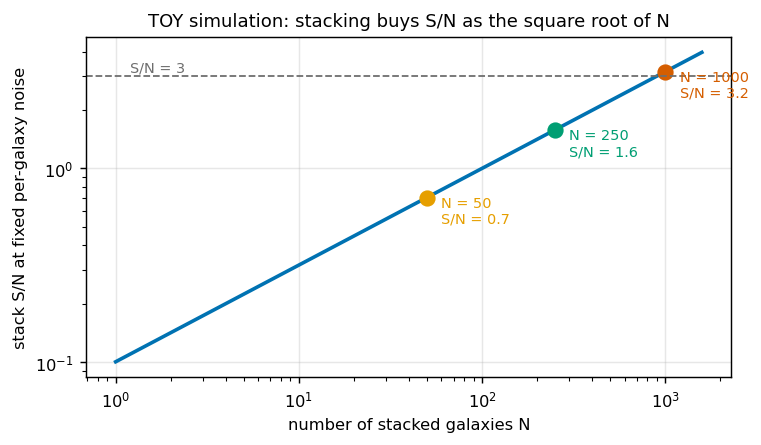
横轴星系数 \(N\)(对数),纵轴叠加信噪比(玩具模型,假定单星系 S/N = 0.10)。虚线 S/N = 3。这是玩具演示,不是项目结果。x: number of galaxies \(N\) (log); y: stack S/N (toy model, per-galaxy S/N = 0.10 assumed). Dashed line: S/N = 3. This is a toy demonstration, not a project result.
统计误差随 \(N\) 缩小、仪器偏置不缩——所以叠加越多场,越需要先量偏置。Statistical noise shrinks with \(N\); an instrumental bias does not — the more you stack, the more you need the bias measured first.
图:handbook scripts/make_figures.py fig_snr.png(玩具模型)Figure: handbook scripts/make_figures.py fig_snr.png (toy model)
17
可跳过:点源掩模深度差 1000 倍——eRASS 与 Chandra 极限之间的光漏进浅叠加Skippable: the point-source mask depth differs by 1000x — light between the eRASS and Chandra limits leaks into a shallow stack
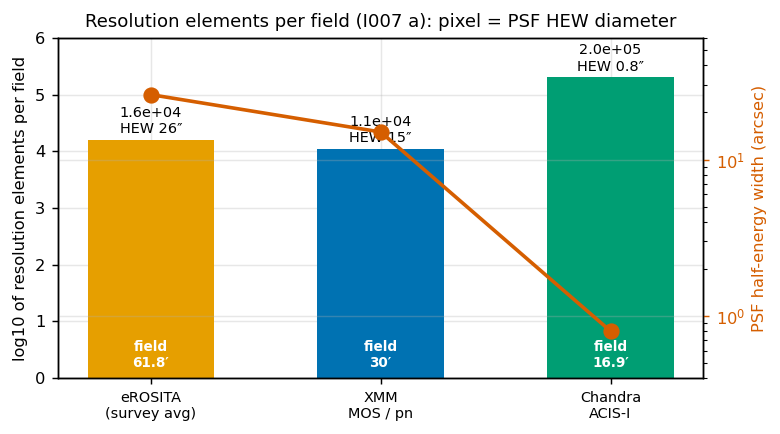
三台仪器的每场分辨元素数(柱,对数轴)与 PSF 半能宽(红线,对数轴)。eROSITA 每场 \(1.6 \times 10^{4}\),XMM \(1.1 \times 10^{4}\),Chandra ACIS-I \(2.0 \times 10^{5}\)。Resolution elements per field (bars, log axis) and PSF half-energy width (red line, log axis) for the three instruments. eROSITA \(1.6 \times 10^{4}\), XMM \(1.1 \times 10^{4}\), Chandra ACIS-I \(2.0 \times 10^{5}\) per field.
Chandra 的亚角秒 PSF 能把点源剔到深得多的极限;两极限之间的光属于谁,是分解实验的一部分。Chandra's sub-arcsecond PSF removes point sources to a much deeper limit; whose light sits between the two limits is part of the decomposition experiment.
图:handbook scripts/make_figures.py fig_psf.png;数据:覆盖普查记录Figure: handbook scripts/make_figures.py fig_psf.png; data: the coverage-census record
18
B2 备份:覆盖普查——Chandra 适合远距离 M* 选样,XMM 多 4–5 倍,eROSITA 数千B2 Backup: the coverage census — Chandra suits distant M* samples, XMM has 4–5 times more, eROSITA thousands
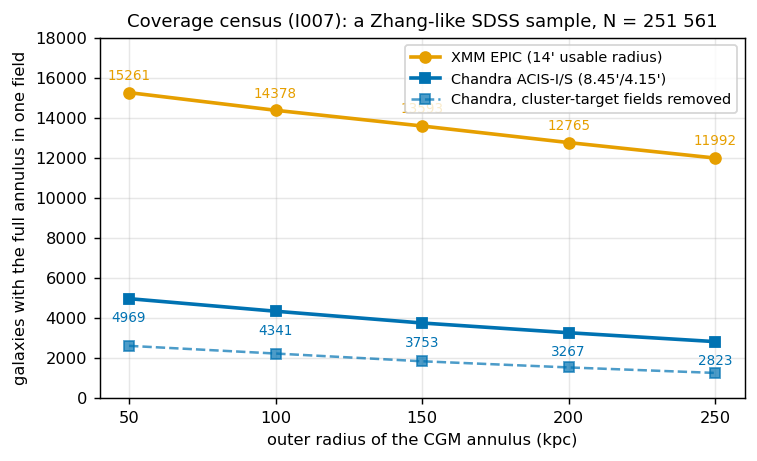
横轴环外半径(kpc),纵轴整环落在单场内的星系数。橙=XMM,蓝=Chandra,虚蓝=去星系团目标场。样本为 Zhang 式 SDSS(\(N = 251\,561\))。x: outer radius of the annulus (kpc); y: galaxies with the full annulus in one field. Orange = XMM, blue = Chandra, dashed blue = cluster-target fields removed. The sample is Zhang-like SDSS (\(N = 251\,561\)).
直接 Vrot 星表只到 \(z \lesssim 0.06\):Vrot 选样的 Chandra 叠加在 150–250 kpc 只有几十颗——所以 Vrot 假设先在 eRASS1 上检验。Direct-Vrot catalogues reach only \(z \lesssim 0.06\): a Vrot-selected Chandra stack has only tens of galaxies at 150–250 kpc — so the Vrot hypothesis is tested first on eRASS1.
图:handbook scripts/make_figures.py fig_census.png;数据:覆盖普查记录Figure: handbook scripts/make_figures.py fig_census.png; data: the coverage-census record
20
B3 备份:分解实验——同星系两方法,一次切换一步B3 Backup: the decomposition experiment — same galaxies, two methods, one switch at a time
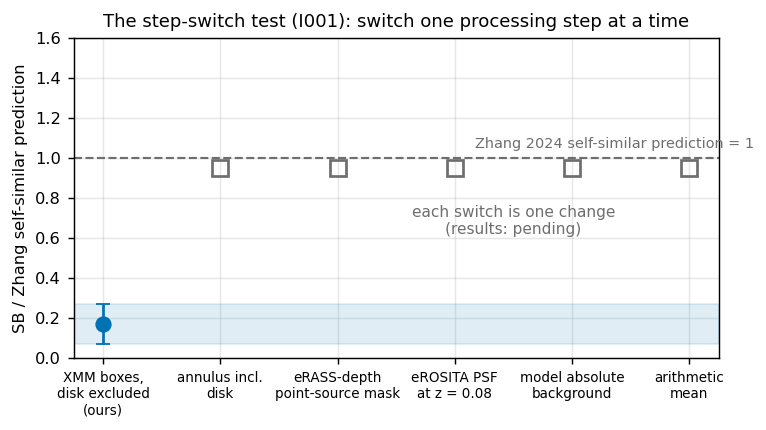
纵轴 SB / Zhang 自相似预测。实心点 = 现测值 \(0.17 \pm 0.10\)(4 星系,Vc 标度);空方块 = 五个未检验的切换步(结果待定)。阴影带 \(0.07\)–\(0.27\)。y: SB / the Zhang self-similar prediction. Filled point = the measured \(0.17 \pm 0.10\) (4 galaxies, Vc scaling); open squares = the five untested switches (results pending). Shaded band \(0.07\)–\(0.27\).
五步:环含盘 → eRASS 深度点源掩模 → eROSITA PSF 卷积 → 模型绝对背景 → 平均方式。每步一个改动,看数字移多少。Five steps: annulus including the disk → eRASS-depth point-source mask → eROSITA PSF convolution → model absolute background → averaging. One change per step, and we watch how far the number moves.
图:handbook scripts/make_figures.py fig_steps_switch.png;数据:项目记录中的分解实验设计Figure: handbook scripts/make_figures.py fig_steps_switch.png; data: the decomposition-experiment design in the project records
21
- 幻灯片 1–3:标题、钩子、路线Slides 1–3: title, hook, roadmap
- 幻灯片 4–6:背景与方法Slides 4–6: background and method
- 幻灯片 7–10:三个结论Slides 7–10: the three messages
- 幻灯片 11–14:意义、局限、下一步Slides 11–14: implications, caveats, next steps
- 幻灯片 15–18:小结与可跳过页Slides 15–18: summary and skippable slides
- 幻灯片 19–22:备份页Slides 19–22: backup slides
- 预期提问与回答Anticipated questions and answers
幻灯片 1 · 标题Slide 1 · Title 累计 0:00cumulative 0:00
各位好。今天讲的工作是关于档案 X 射线数据里怎么测星系周介质——更准确地说,是关于在测之前必须先做的一件事:量你自己的仪器。Good morning. Today's talk is about measuring the circumgalactic medium from archival X-ray data — more precisely, about the one thing you must do before measuring it: measure your own instrument.
标题里有两个主张。第一,NGC 5746 的中心超额是真的。第二,MOS 相机在中央 CCD 上有一个随场而变的偏置,没有全局常数。我会一条一条给证据。The title carries two claims. First, the NGC 5746 central excess is real. Second, the MOS cameras carry a field-dependent bias at the central CCD, with no global constant. I will give the evidence for each in turn.
这个报告约三十分钟,之后留十到十五分钟提问。This talk is about thirty minutes, with ten to fifteen minutes for questions afterwards.
幻灯片 2 · 钩子与承诺Slide 2 · Hook and promise 累计 1:30cumulative 1:30
先看这张图。横轴是投影半径,单位千秒差距,双对数;纵轴是面亮度。蓝线是 Zhang 等人 2024 年用 eROSITA 叠加得到的银河系质量档结果,橙方块是 He 与 Li 2026 年用 eRASS1 叠加 474 颗 L* 星系的结果。两条叠加曲线在十到五十秒差距都有明确发射。Start with this figure. The x-axis is projected radius in kiloparsecs, log–log; the y-axis is surface brightness. The blue line is the Milky-Way-mass bin that Zhang et al. 2024 obtained by stacking eROSITA data; the orange squares are the He & Li 2026 stack of 474 L* galaxies from eRASS1. Both stacks show clear emission at ten to fifty kiloparsecs.
空心符号是我们对邻近侧向旋涡星系逐个分辨的 XMM-Newton 上限,绿箭头是档案预报值。它们落在叠加曲线下面,差大约五倍。The open symbols are our resolved, galaxy-by-galaxy XMM-Newton upper limits for nearby edge-on spirals, and the green arrows are archival forecasts. They sit below the stacks, by about a factor of five.
五倍的差别有两种读法:要么叠加被方法学偏差推高了,要么我们的分辨测量漏掉了辐射。要判定,需要一个"同一批星系、两种方法"的分解实验。A factor of five has two readings: either the stacks are inflated by a methodological bias, or our resolved measurements miss flux. Deciding needs a "same galaxies, two methods" decomposition experiment.
但今天不讲那个。今天讲一个更前置的问题:在分解之前,XMM 这台仪器在目标位置本身制造多少信号?三十分钟后,你会知道这个数,以及为什么档案叠加必须逐场减零值。But that is not today. Today is about a prior question: before decomposing, how much signal does the XMM instrument itself make at the target position? In thirty minutes you will know that number, and why archival stacks must subtract nulls field by field.
幻灯片 3 · 路线Slide 3 · Roadmap 累计 3:00cumulative 3:00
路线四步。先讲背景:热星系周介质是什么,X 射线背景是什么,为什么这件事难。然后讲方法:零信号对照叠加怎么做。接着是三个带回家的结论。最后是局限和下一步。Four parts. First the background: what the hot circumgalactic medium is, what the X-ray backgrounds are, and why this is hard. Then the method: how the null-signal control stack works. Then three take-home messages. Finally the caveats and next steps.
我会把小标题当作论点来讲,每张图我都会说明坐标轴、颜色和该看什么。I will treat each headline as an assertion, and for every figure I will say what the axes and colours are and what to look at.
幻灯片 4 · 物理背景Slide 4 · Physics background 累计 5:00cumulative 5:00
一分钟的物理。星系形成模型给银河系质量星系大约 \(6 \times 10^{10}\) 太阳质量的恒星;宇宙学重子预算说大部分重子不在恒星里,而在暗晕的热气体里——星系周介质。这团气体的温度在百万开尔文量级,主要在软 X 射线发亮,所以只能用 X 射线测。One minute of physics. Galaxy-formation models give a Milky-Way-mass galaxy about \(6 \times 10^{10}\) solar masses in stars; the baryon budget says most baryons are not in the stars but in the hot gas of the dark halo — the circumgalactic medium. That gas sits at millions of Kelvin, shines in soft X-rays, and is only measurable in X-rays.
为什么难?看下面这个框。第一,CGM 是延展的:模型范数只有每平方角分百分之几乘十的负六次方,摊在角分量级的天区上。第二,同样的光子来自宇宙 X 射线背景和探测器内部的粒子背景、软质子。第三,所以每次测量都是两个大数相减,信号约为背景的百分之一量级。结论写在最后一行:差必须在同一位置取——同一探测器位置、同一天空。Why is it hard? Look at the box below. First, the CGM is diffuse: the model norm is a few times ten to the minus six per square arcminute, spread over arcminutes. Second, the same photons come from the cosmic X-ray background and from the particle and soft-proton backgrounds inside the detector. Third, every measurement is therefore a small difference of two large numbers, with the signal of order one percent of the background. The conclusion is the last line: the difference must be taken at the same place — same detector position, same sky.
带着这句话,我们看下一张,XMM 的探测器几何。With that sentence in mind, look at the next slide: the XMM detector geometry.
幻灯片 5 · CCD1 问题Slide 5 · The CCD1 problem 累计 7:30cumulative 7:30
左图是 MOS1 相机的焦平面示意。蓝色块是中央 CCD,编号 CCD1;XMM 的每个科学目标都坐在它的中心,因为那里分辨率和灵敏度最好。绿色虚线框是参照框——减背景用的空白区——通常在外圈 CCD 或视场边缘。The left panel is a schematic of the MOS1 focal plane. The blue block is the central CCD, called CCD1; every XMM science target sits at its centre, where the resolution and sensitivity are best. The green dashed box is the reference box — the blank region used to subtract the background — usually on outer CCDs or at the field edge.
右图是叠加对偏置做什么。假设每个场的幅度等于信号加一个偏置 b。第一场如此,第二场如此,第 N 场也如此。平均之后,偏置还在——它不随场数平均掉,因为它在每场同号。而按观测抽样的 jackknife,每场只出现一次,看不见它。The right panel shows what stacking does to a bias. Suppose each field's amplitude is the signal plus a bias b. Field one, so; field two, so; field N, so. After averaging, the bias is still there — it does not average down, because it has the same sign in every field. And a jackknife that samples by observation sees each field only once, so it cannot see it.
已有的控制框——盘上方二十七到五十千秒差距的空白框——不在 CCD1 中心,所以测不到这个位置。这个位置从未被直接测过。我们的对照叠加就是为了测它。The existing control boxes — blank boxes twenty-seven to fifty kiloparsecs above the disk — are not on the CCD1 centre, so they cannot measure this position. This position has never been measured directly. Our control stack exists to measure it.
幻灯片 6 · 方法Slide 6 · Method 累计 10:00cumulative 10:00
方法三步。第一步,选零场:只用档案元数据——XSA、HEASARC、VizieR、SIMBAD 的 TAP 查询加一张 HI4PI 图。规则:MOS1 全帧;与科学观测同一 MOS1 损失历元;同一滤光片类别;时间差五年内;曝光在科学值零点五到四倍之间;氢柱密度两倍内;银纬绝对值大于十五度;十五角分内没有延展源。暗场和点源场两类都要。The method has three steps. Step one, select the nulls, using archive metadata only — TAP queries to XSA, HEASARC, VizieR and SIMBAD, plus one HI4PI map. The rules: MOS1 Full Frame; the same MOS1-loss epoch as the science observation; the same filter class; within five years in time; exposure between half and four times the science value; hydrogen column within a factor of two; Galactic latitude above fifteen degrees; and no extended source within fifteen arcminutes. Both dark fields and point-source fields are required.
第二步,转移区域:把 NGC 5746 的十九区布局——一到八角分径向箱、十点一到三十千秒差距高度、八到十一和十一到十四角分参照框——按位置角差绕零场指向旋转,星系中心的瞄准偏移同样旋转。Step two, transfer the regions: the NGC 5746 nineteen-region layout — one-to-eight-arcminute radial boxes, ten-point-one to thirty kiloparsec heights, eight-to-eleven and eleven-to-fourteen arcminute reference boxes — is rotated about the null pointing by the position-angle difference, with the galaxy centre's aimpoint offset rotated the same way.
第三步,同一引擎:锁定的 ESAS v1.7.2 案例流水线,与科学数据同引擎、同掩模、同估计量;每个案例二十个文件做 sha256 校验。Step three, the same engine: the pinned ESAS v1.7.2 case pipeline, the same engine, masks and estimator as the science data, with twenty sha256-verified files per case.
橙色框是自检:把位置角差设为零,恒等转移把 NGC 5746 区域复现到零点零零零零角秒。引擎和几何无误。最后一句是场数:初选十个,两个在还原前因档案元数据冲突被替换,一个还原后判为耀斑主导退役,剩九个活动场,十八个场侧,每个八径向箱。The orange box is the self-check: set the position-angle difference to zero, and the identity transfer reproduces the NGC 5746 regions to zero-point-zero-zero-zero-zero arcseconds. The engine and geometry are correct. The last line counts the fields: ten selected, two replaced before reduction after archive-metadata conflicts, one retired after reduction as flare-dominated, leaving nine active fields, eighteen field-sides, eight radial boxes each.
现在数据好了,我们看结果。Now that the data are in hand, let us look at the results.
幻灯片 7 · 结论 1Slide 7 · Message 1 累计 12:30cumulative 12:30
第一个结论。NGC 5746 的科学超额超过它自己的两个零场。看图:横轴是科学值减零场的幅度,单位是十的负六次方 APEC 范数每平方角分;灰线是零。蓝色条是 MOS:正零点九八加减零点一八,五点五西格玛。橙色条是 pn:正零点八七加减零点一四,六点四西格玛。Message one. The NGC 5746 science excess exceeds its own two nulls. Look at the figure: the x-axis is the science-minus-null amplitude in units of ten to the minus six APEC norm per square arcminute; the grey line is zero. The blue bar is MOS: plus zero-point-nine-eight plus-or-minus zero-point-one-eight, five-point-five sigma. The orange bar is pn: plus zero-point-eight-seven plus-or-minus zero-point-one-four, six-point-four sigma.
为什么这能说明不是仪器?两个原因。第一,MOS 和 pn 是两台独立的探测器,背景处理不同,却给出同号同量级的结果。第二,这个差值已经减掉了同一探测器位置上的零场——一个探测器位置的伪影应该被自己的零场吸收掉。Why does this rule out the instrument? Two reasons. First, MOS and pn are two independent detectors with different background handling, and they agree in sign and size. Second, this difference has already subtracted nulls at the same detector position — a detector-position artefact should be absorbed by its own null.
注意这是配对比较:科学值只减它自己的两个零场,不用任何全局常数。所以结论是:超额是真发射,或者是这次观测特有的污染——但不是探测器位置的仪器伪影。Note this is a paired comparison: the science value is reduced only by its own two nulls, with no global constant. So the conclusion is: the excess is real emission, or a contaminant specific to that observation — but not a detector-position artefact.
幻灯片 8 · 结论 2Slide 8 · Message 2 累计 15:30cumulative 15:30
第二个结论。零场本身不是零。看图:每行一个零场,横轴是 MOS 幅度。蓝圆是标准拟合——每侧一天空;红菱形是稳定天空重拟合——一场一天空。红带是七个常规场的稳定天空均值。Message two. The nulls themselves are not zero. Look at the figure: one row per null field, the x-axis is the MOS amplitude. Blue circles are the standard fits — one sky per side; red diamonds are the stable-sky refits — one sky per field. The red band is the seven-normal-field stable-sky mean.
数字在右边。pn:六个零场的反方差平均是负零点零二加减零点零六——与零一致。MOS:十八个场侧平均负零点一九加减零点零六。而且 MOS 的偏置随场而变:七个常规背景场负零点三七加减零点零八,两个硬超额场正零点零六加减零点一零——两组差零点四三加减零点一二,三点四西格玛。The numbers are on the right. pn: the inverse-variance mean of six nulls is minus zero-point-zero-two plus-or-minus zero-point-zero-six — consistent with zero. MOS: eighteen field-sides average minus zero-point-one-nine plus-or-minus zero-point-zero-six. And the MOS offset is field-dependent: seven normal-background fields give minus zero-point-three-seven plus-or-minus zero-point-zero-eight, two hard-excess fields give plus zero-point-zero-six plus-or-minus zero-point-one-zero — the groups differ by zero-point-four-three plus-or-minus zero-point-one-two, three-point-four sigma.
换句话说:仪器在每个探测器位置都带着一个偏置,但它的太小由场自己决定。这就排除了"一个常数修正一切"的可能——我们刚在结论一里看到,常数会破坏 MOS 与 pn 的一致性。In other words: the instrument carries a bias at every detector position, but its size is set by the field itself. That already rules out "one constant fixes everything" — we saw in message one that the constant breaks the MOS–pn agreement.
幻灯片 9 · 已排除的解释Slide 9 · Ruled-out explanations 累计 18:30cumulative 18:30
那么偏置从哪来?我们按预注册规则检验了三个解释。图上三行,每行一个解释:左边是假设,中间是两个数字,右边是判决。So where does the offset come from? We tested three explanations, each under a pre-registered rule. Three rows in the figure: hypothesis on the left, two numbers in the middle, verdict on the right.
第一行:冻结的软质子谱指数。放开指数,三个常规场的均值从负零点四三动到负零点四四——不动,判决:拒绝。第二行:pn 的静止粒子背景通过联合天空泄漏进 MOS。把 pn 从视野里拿掉、用 MOS-only 天空重拟合,均值从负零点四三动到负零点三五——只动了零点零八,在预注册阈值的边界上,判决:拒绝。第三行:每侧的天空不稳定。用一场一天空重拟合,均值从负零点三七动到负零点二七——动了零点一零加减零点一一,按规则判"不确定"。Row one: the frozen soft-proton spectral index. Free it, and the three-field mean moves from minus zero-point-four-three to minus zero-point-four-four — no move. Verdict: rejected. Row two: the pn quiescent-particle background leaking into MOS through the joint sky. Remove pn from the view and refit with a MOS-only sky: the mean moves from minus zero-point-four-three to minus zero-point-three-five — only zero-point-zero-eight, on the boundary of the pre-registered threshold. Verdict: rejected. Row three: the per-side sky is unstable. Refit with one sky per field: the mean moves from minus zero-point-three-seven to minus zero-point-two-seven — a shift of zero-point-one-zero plus-or-minus zero-point-one-one. By the rule: ambiguous.
两点要强调。第一,这些规则是在任何结果出来之前写好的——我们不是在猜原因后找数字。第二,每行的两个均值用同一批数据,所以差值不是独立区间。三个解释之后,偏置还在,成因未定。Two points. First, these rules were written before any result existed — we did not guess a cause and then look for numbers. Second, the two means in each row use the same data, so the shift is not an independent interval. After all three, the offset is still there, and its origin is open.
幻灯片 10 · 没有单一预测量Slide 10 · No single predictor 累计 21:00cumulative 21:00
我们还试了十九个候选预测量。看图:横轴是硬波段比——科学框计数除以静止粒子背景模型,九点五到十二千电子伏;纵轴是 MOS 幅度。蓝圆是 MEDIUM 滤光片,橙三角是 THIN1。红线是十八场侧的均值。没有一个预测量达到二点二西格玛。We also tried nineteen candidate predictors. Look at the figure: the x-axis is the hard-band ratio — science-box counts over the quiescent-particle-background model at nine-point-five to twelve kilo-electron-volts; the y-axis is the MOS amplitude. Blue circles are MEDIUM filter, orange triangles THIN1. The red line is the eighteen-side mean. No predictor reaches two-point-two sigma.
但有一个异常值得记住:天空在必须稳定的地方不稳定。同一场的南北两个参照框给出不同的天空——本地热气泡范数差一百倍;NGC 5746 的四个历元,同一天空,给出宇宙 X 射线背景从零到三点八乘十的负七次方。这说明第一步的天空拟合有真正的简并,是偏置的候选来源之一。But one anomaly is worth remembering: the sky is not stable where it must be. The north and south reference boxes of the same field give different skies — the local-hot-bubble norm differs by a factor of one hundred; the four NGC 5746 epochs, the same sky, give a cosmic X-ray background from zero to three-point-eight times ten to the minus seven. So the step-one sky fit carries a genuine degeneracy, one candidate source of the offset.
现在把三条证据放在一起,就得到结论三。Now put the three pieces together, and we reach message three.
幻灯片 11 · 结论 3Slide 11 · Message 3 累计 23:30cumulative 23:30
第三个结论,也是今天最想留下的:不存在全局常数修正。图上左右对比。左边橙色框:用曾经提议的全局常数加零点三零。NGC 5746 的 MOS 变成正零点八一加减零点一三,pn 是正一点零零加减零点零九——两台相机现在差一点二西格玛。为什么?因为 NGC 5746 自己的两个零场在负零点四七和负零点三一,常数零点三零对这个场是错的。Message three, and the one I most want to leave with you: there is no global constant correction. The figure compares the two rules. Left, the orange box: use the once-proposed global constant of plus zero-point-three-zero. NGC 5746's MOS becomes plus zero-point-eight-one plus-or-minus zero-point-one-three, and pn is plus one-point-zero-zero plus-or-minus zero-point-zero-nine — the two cameras now differ by one-point-two sigma. Why? Because NGC 5746's own two nulls sit at minus zero-point-four-seven and minus zero-point-three-one, so a constant of zero-point-three-zero is wrong for this field.
右边绿色框:用配对零值。MOS 正零点九八加减零点一八,pn 正零点八七加减零点一四——两台相机同号同量级,没有一个数字在场与场之间搬运。Right, the green box: use the pairing-specific nulls. MOS plus zero-point-nine-eight plus-or-minus zero-point-one-eight, pn plus zero-point-eight-seven plus-or-minus zero-point-one-four — the two cameras agree in sign and magnitude, and no number is carried between fields.
下面解释为什么常数不可能存在:偏置的大小由场自己的硬波段超额决定,而硬波段超额场场不同。所以 N 场的叠加要带 N 个不同的修正;两个叠加相减,差值里就混进一个未量化的仪器项。结论写在最下面一行:任何档案 CGM 叠加都必须逐场减去配对零值。Below, why a constant cannot exist: the offset's size is set by the field's own hard-band excess, and that varies field to field. So a stack of N fields would carry N different corrections; the difference between two stacks mixes in an unquantified instrumental term. The conclusion is the bottom line: any archival CGM stack must subtract pairing-specific nulls.
幻灯片 12 · 对别人的意义Slide 12 · What this means for others 累计 26:00cumulative 26:00
这张图把我们的设计和常规档案叠加并排放。左边:常规做法逐观测分别拟合盘上和盘平面区域,参照框在外圈 CCD 或视场边缘,jackknife 按观测抽样——所以看不见 CCD1 中心的偏置。右边:我们的参照框放在同一个 CCD1 中心,零场目标、同一引擎、同一估计量,直接测那个位置。This figure puts our design next to a standard archival stack. Left: the usual practice fits the above-disk and disk-plane regions separately per observation, with reference boxes on outer CCDs or the field edge, and a jackknife that samples by observation — so it cannot see a CCD1-centre bias. Right: our reference box sits at the same CCD1 centre, with a null target, the same engine and the same estimator, measuring that position directly.
我要说清楚:这不是对已有叠加的指责。那是一个他们没测的位置,也是一个可以复用的设计。中间那句话是重点:在分解那个五倍矛盾之前,XMM 侧必须先知道自己在目标位置的仪器偏置。我们的答案是:偏置存在、随场而变、没有常数。Let me be clear: this is not an accusation against existing stacks. It is a position they did not measure, and a design they can reuse. The middle sentence is the key one: before decomposing that factor-of-five tension, the XMM side must know its own instrumental bias at the target position. Our answer: the bias exists, is field-dependent, and has no constant.
主问题——哪一步处理造成五倍——今天仍未判定。本工作给出的是前置条件。The main question — which processing step makes the factor of five — remains open today. This work supplies the precondition.
幻灯片 13 · 局限Slide 13 · Caveats 累计 28:30cumulative 28:30
诚实地说局限,四条。第一条:九个零场全是银河系高纬暗场或点源场,没有星系团场——而团场是档案的一大块,偏置在团场可能不同。第二条:单位是模型范数,十的负六次方 APEC 范数每平方角分,温度零点三千电子伏,不是物理面亮度;跨论文比较要先做模型转换。第三条:不确定度是一西格玛、纯统计;掩模选择和天空模型没有传播;而且稳定天空和标准拟合用同一批数据,它们的差不是独立区间。第四条:零场测的是那个探测器位置上的通用仪器响应,不测这次观测自己的软质子、太阳风电荷交换或未分辨源。Now the caveats, honestly, four of them. One: all nine nulls are high-latitude Galactic dark or point-source fields; there are no cluster fields, and clusters are a large part of the archive, so the offset may differ there. Two: the unit is a model norm, ten to the minus six APEC norm per square arcminute at zero-point-three kilo-electron-volts, not a physical surface brightness; cross-paper comparison needs a model conversion first. Three: the uncertainties are one sigma and statistical; mask choice and the sky model are not propagated; and the stable-sky and standard fits use the same data, so their difference is not an independent interval. Four: a null field tests the generic instrument response at that detector position, not that observation's own soft protons, solar-wind charge exchange, or unresolved sources.
所以:我们不知道 MOS 偏置的成因。三个候选被排除,天空模型、静止粒子背景谱形和 CCD 组合仍在。So: we do not know the origin of the MOS offset. Three candidates are excluded; the sky model, the quiescent-particle-background shape and the CCD set remain.
幻灯片 14 · 下一步Slide 14 · Next steps 累计 30:30cumulative 30:30
两个已提出、未启动的检验,专门用来分开"天空"和"时变的 QPB 与软质子"。左边:把宇宙 X 射线背景固定在预期的未分辨水平,而不是让第一步自由拟合它;如果偏置朝零移动,天空分解就是原因。右边:NGC 5746 的四个历元——同一天空,不同的静止粒子背景和软质子——用一个天空跨四个历元拟合;时变量解释不了一个共有的天空误差。Two proposed, not-yet-launched tests, designed to separate "sky" from "time-variable QPB and soft protons". Left: fix the cosmic X-ray background at the expected unresolved level instead of letting step one fit it freely; if the offset moves towards zero, the sky decomposition is the cause. Right: the four NGC 5746 epochs — the same sky, different quiescent-particle background and soft protons — fitted with one sky across all four epochs; time-variable components cannot explain a shared sky error.
两个检验都停泊着,等校准项目完成当前工作。同时设计本身现在就能复用:选零场、转区域、同引擎、逐场减配对零值。Both tests are parked until the calibration project finishes its current work. Meanwhile the design itself is reusable as it stands: select nulls, transfer regions, use the same engine, subtract pairing-specific nulls.
最下面两行标为"建议(未经评审)":MOS 增益或暗流在 CCD1 与外圈的差异,以及低计数箱里 CCD1 读出伪影的残余。这些不在项目已登记的决策里,需要评审。The last two lines are labelled "Suggestion (not reviewed)": MOS gain or dark-current differences between CCD1 and the outer CCDs, and residual CCD1 read-out artefacts in low-count boxes. These are not in the project's registered decisions and need review.
幻灯片 15 · 小结Slide 15 · Summary 累计 32:00cumulative 32:00
小结,三条。第一:NGC 5746 的超额不是探测器位置的仪器伪影——MOS 正零点九八加减零点一八,五点五西格玛;pn 正零点八七加减零点一四,六点四西格玛,都是减掉它自己的两个零场。第二:MOS 在 CCD1 中心的偏置是真的、随场而变——七个常规场负零点三七加减零点零八,稳定天空重拟合后负零点二七加减零点零八;两个硬超额场正零点零六加减零点一零;pn 是零。第三:没有全局常数修正——任何档案 CGM 叠加必须逐场减配对零值。设计本身可以直接复用。The summary, three messages. One: the NGC 5746 excess is not a detector-position artefact — MOS plus zero-point-nine-eight plus-or-minus zero-point-one-eight, five-point-five sigma; pn plus zero-point-eight-seven plus-or-minus zero-point-one-four, six-point-four sigma, both over its own two nulls. Two: the MOS offset at the CCD1 centre is real and field-dependent — seven normal fields minus zero-point-three-seven plus-or-minus zero-point-zero-eight, minus zero-point-two-seven plus-or-minus zero-point-zero-eight after the stable-sky refit; two hard-excess fields plus zero-point-zero-six plus-or-minus zero-point-one-zero; pn is zero. Three: no global constant correction exists — any archival CGM stack must subtract pairing-specific nulls. The design itself is directly reusable.
这一页在提问期间会留着。谢谢各位。This slide stays up during questions. Thank you.
幻灯片 16 · 可跳过:仪器几何Slide 16 · Skippable: instrument geometry 累计 34:00cumulative 34:00
(可跳过:时间不够时直接跳到小结页后的备份页)(Skippable: if time is short, jump straight from here to the backup slides.)
如果还有时间,三张可跳过的背景页。这张讲几何。横轴距离,纵轴一角分对应的物理尺度。竖虚线是二百五十千秒差距恰好填满 XMM 十四角分可用视场的距离——六十一百万秒差距。三个点是 He 与 Li 样本、Zhang 的中位红移、HyperLEDA 的 Vrot 中位距离。If there is time, three skippable background slides. This one is geometry. The x-axis is distance, the y-axis the physical scale of one arcminute. The vertical dotted line is the distance where two hundred fifty kiloparsecs exactly fills the XMM fourteen-arcminute usable field — sixty-one megaparsecs. The three points are the He & Li sample, the Zhang median redshift, and the HyperLEDA Vrot median distance.
结论:远星系把整个晕装进小视场,所以叠加可行;近星系装不下,所以必须逐星分辨。这是两套方法各有所长的几何根源,也是为什么 eROSITA 叠加远星系、我们测近星系。The conclusion: distant galaxies fit the whole halo into a small field, so stacking works; nearby ones do not, so each galaxy must be resolved. That is the geometric root of why the two methods each have their place, and why eROSITA stacks distant galaxies while we measure nearby ones.
幻灯片 17 · 可跳过:信噪比Slide 17 · Skippable: signal-to-noise 累计 35:30cumulative 35:30
(可跳过)(Skippable.)
这张是玩具演示,不是项目结果。横轴星系数,对数;纵轴叠加信噪比,假定单星系信噪比零点一零。信号按 N 增长、噪声按根号 N 增长,所以信噪比按根号 N 增长。虚线是信噪比等于三。This is a toy demonstration, not a project result. The x-axis is the number of galaxies, logarithmic; the y-axis is the stack signal-to-noise, assuming a per-galaxy signal-to-noise of zero-point-one-zero. The signal grows as N, the noise as the square root of N, so the signal-to-noise grows as the square root of N. The dashed line is a signal-to-noise of three.
但对本报告最重要的是:统计误差随 N 缩小,仪器偏置不缩。所以叠得越多场,越需要先把偏置量出来——这正是今天这项工作的动机。But the point that matters most for this talk is: statistical noise shrinks with N, an instrumental bias does not. So the more you stack, the more you need the bias measured first — which is exactly why today's work exists.
幻灯片 18 · 可跳过:分辨元素Slide 18 · Skippable: resolution elements 累计 37:00cumulative 37:00
(可跳过)(Skippable.)
最后一张可跳过页。柱是每场分辨元素数,对数轴,像素取点扩散函数半能宽直径;红线是半能宽,也是对数轴。eROSITA 每场一点六乘十的四次方,XMM 一点一乘十的四次方,Chandra 的 ACIS-I 二点零乘十的五次方——因为 Chandra 有亚角秒的点扩散函数。The last skippable slide. The bars are resolution elements per field on a log axis, with the pixel taken as the point-spread-function half-energy-width diameter; the red line is the half-energy width, also on a log axis. eROSITA gives one-point-six times ten to the fourth per field, XMM one-point-one times ten to the fourth, and Chandra's ACIS-I two-point-zero times ten to the fifth — because Chandra has a sub-arcsecond point spread function.
这直接关系到点源掩模深度:Chandra 能把点源剔到深得多的极限。两个极限之间的光属于谁,是分解实验的一部分。This bears directly on the point-source mask depth: Chandra can remove point sources to a much deeper limit. Whose light sits between the two limits is part of the decomposition experiment.
幻灯片 19 · B1 备份Slide 19 · B1 Backup 累计 37:30cumulative 37:30
(备份页,不在正片里讲;提问时用)(Backup slide, not spoken in the main talk; used for questions.)
九个零场的逐场幅度表,十点一到三十千秒差距。MOS 一列、pn 一列,单位十的负六次方 APEC 范数每平方角分。两个硬超额场是表格里唯一 MOS 翻正的场。The per-field amplitude table for the nine nulls, ten-point-one to thirty kiloparsecs. MOS in one column, pn in the other, in units of ten to the minus six APEC norm per square arcminute. The two hard-excess fields are the only ones where MOS flips positive.
幻灯片 20 · B2 备份Slide 20 · B2 Backup 累计 38:00cumulative 38:00
(备份页)(Backup slide.)
覆盖普查。横轴环外半径,纵轴整环落在单场内的星系数,样本是 Zhang 式 SDSS。橙线 XMM,蓝线 Chandra,虚线是去掉星系团目标场。直接 Vrot 星表只到红移零点零六左右,所以 Vrot 选样的 Chandra 叠加在一百五十到二百五十千秒差距只有几十颗——Vrot 假设先在 eRASS1 上检验。The coverage census. The x-axis is the outer annulus radius, the y-axis the number of galaxies with the full annulus in one field, for a Zhang-like SDSS sample. Orange is XMM, blue is Chandra, dashed blue removes cluster-target fields. Direct-Vrot catalogues reach only redshift zero-point-zero-six or so, so a Vrot-selected Chandra stack has only tens of galaxies at one hundred fifty to two hundred fifty kiloparsecs — hence the Vrot hypothesis is tested first on eRASS1.
幻灯片 21 · B3 备份Slide 21 · B3 Backup 累计 38:30cumulative 38:30
(备份页)(Backup slide.)
分解实验的设计。纵轴是面亮度除以 Zhang 自相似预测。实心点是现测值零点一七加减零点一零;五个空方块是五个未检验的切换步:环含盘、eRASS 深度点源掩模、eROSITA 点扩散函数卷积、模型绝对背景、平均方式。每步只改一处,看数字移多少。这就是"同星系两方法"实验。The design of the decomposition experiment. The y-axis is surface brightness over the Zhang self-similar prediction. The filled point is the measured zero-point-one-seven plus-or-minus zero-point-one-zero; the five open squares are the five untested switches: the annulus including the disk, the eRASS-depth point-source mask, the eROSITA point-spread-function convolution, the model absolute background, and the averaging. One change per step, watching how far the number moves. That is the "same galaxies, two methods" experiment.
幻灯片 22 · B4 备份Slide 22 · B4 Backup 累计 39:00cumulative 39:00
(备份页)(Backup slide.)
最后一张备份页回答"你们现在在做什么"。两条并行线:Chandra 试点和 eRASS1 Vrot 检验。左框:覆盖普查已完成,现实选样重数给约一千零六十九颗中央星系到一百五十千秒差距;信噪比预报仍在评审——即便只算光子统计,银河系质量档五十到一百五十千秒差距也到不了三西格玛;当前计划是高质量十到五十千秒差距试点,预报约五西格玛,作为工具检验。右框:Vrot 分组的预注册规则已与负责人商定,预报信噪比十到二十三西格玛,条件于质量斜率;"Vrot 是更好代理"这个论断本身也在红队评审中。The last backup slide answers "what are you doing now". Two parallel lines: the Chandra pilot and the eRASS1 Vrot test. Left box: the coverage census is done, and the realistic-sample recount gives about one thousand sixty-nine centrals to one hundred fifty kiloparsecs; the signal-to-noise forecasts are under review — even photon-only, the Milky-Way-mass fifty-to-one-hundred-fifty kiloparsec stack stays below three sigma; the current plan is a high-mass ten-to-fifty kiloparsec pilot with a forecast of about five sigma, as a tool test. Right box: the pre-registered Vrot split rule is agreed with the owner, with a forecast signal-to-noise of ten to twenty-three sigma, conditional on the mass slope; the "Vrot is the better proxy" argument itself is under red-team review.
要强调:这一页上所有数字都是待定,不是结论;三条带回家的信息只基于已完成的零信号对照叠加。To be clear: every number on this slide is pending, not a result; the three take-home messages rest only on the completed null-signal control stack.
预期提问与回答(提问环节 10–15 分钟)Anticipated questions and answers (10–15 min question period)
以下是最可能被问到的问题与准备好的回答;每条注明所用备份页。"还不知道"是允许的回答。The most likely questions with prepared answers; each names the backup slide it uses. "We do not know yet" is an allowed answer.
Q1. 九个零场够吗?(样本量)Are nine null fields enough?
对"偏置不为零、随场而变"这两个定性结论,够:两组的分离是 \(3.4\sigma\),每组内部一致(常规场 \(\chi^2 = 2.3\) 自由度 6)。对"偏置的成因",不够——成因未定,这正是下一步检验的目标。B1。For the two qualitative conclusions — the offset is not zero and is field-dependent — yes: the two groups separate at \(3.4\sigma\), and each group is internally consistent (the normal fields give \(\chi^2 = 2.3\) for 6 degrees of freedom). For the origin of the offset, no — that is open, and it is the target of the next tests. B1.
Q2. 零场测的是"通用仪器响应",那 NGC 5746 自己的软质子或电荷交换呢?A null field tests the generic instrument response — what about NGC 5746's own soft protons or charge exchange?
答不了,这是列在局限第四条里的边界。零场测不到这次观测特有的污染。所以结论的措辞是"不是探测器位置的仪器伪影",不是"是真发射"。区分这两者需要 NGC 5746 的多历元检验(下一步之一)。B4。It cannot — that is limitation four. A null field does not test that observation's own contaminants. So the conclusion is worded "not a detector-position artefact", not "real emission". Separating those needs the NGC 5746 multi-epoch test, one of the next steps. B4.
Q3. 你们的幅度单位不是物理面亮度,怎么和 eROSITA 比?Your amplitude unit is not a physical surface brightness — how do you compare with eROSITA?
本工作不直接比。我们量的是同一估计量下的差分幅度(科学减零场);要转成物理面亮度需要先固定一个模型转换。这是局限第二条。分解实验(B3)在转换单位下做。B3。This work does not compare directly. We measure differential amplitudes under one estimator, science minus null; converting to a physical surface brightness needs a fixed model conversion first. That is limitation two. The decomposition experiment (B3) works in converted units. B3.
Q4. 为什么不用 ESAS 自带的 blank-sky 背景或 stowed 数据?Why not use the blank-sky or stowed backgrounds that ESAS provides?
因为问题不在绝对背景的水平,而在"同一探测器位置上科学框与参照框的差"。blank-sky 模板是全视场平均的粒子模型,它不携带 CCD1 中心与外圈之间可能的空间失配。我们的零场把参照框放到同一位置,直接测那个差。Because the problem is not the absolute background level but the difference between the science box and the reference box at the same detector position. A blank-sky template is a field-average particle model; it does not carry a possible CCD1-versus-outer spatial mismatch. Our nulls put the reference box at the same position and measure that difference directly.
Q5. 稳定天空把偏置从 −0.37 移到 −0.27——这不说明天空就是原因吗?The stable sky moves the offset from −0.37 to −0.27 — doesn't that mean the sky is the cause?
按预注册规则,这个移动(\(+0.10 \pm 0.11\))判"不确定":移动量与误差同量级,且两个均值用同一批数据,不是独立区间。能说的是"不稳定的天空贡献了约 +0.1",剩下的 \(-0.27 \pm 0.08\) 仍需解释。B4。By the pre-registered rule that shift (\(+0.10 \pm 0.11\)) is ambiguous: the shift is of order its error, and the two means use the same data, so it is not an independent interval. What can be said is that an unstable sky contributes about +0.1; the remaining \(-0.27 \pm 0.08\) still needs a cause. B4.
Q6. 这个偏置会不会也影响 eROSITA 自己的叠加?Could this bias also affect the eROSITA stacks themselves?
本工作不判定 eROSITA 侧:那是不同仪器、不同背景结构,我们没有测过它的探测器位置。我们的主张只覆盖 XMM 档案叠加。主问题(哪一步造成五倍)仍开放。B3。This work does not judge the eROSITA side: that is a different instrument with a different background structure, and we have not measured its detector positions. Our claim covers XMM archival stacks only. The main question — which step makes the factor of five — remains open. B3.
Q7. 为什么不直接把 AGN/星暴清干净后用 XMM 档案叠加?Why not simply clean the XMM archive of AGN and starbursts and stack it?
项目里做过这个清点:十五到五十百万秒差距内剔除后只剩约十五到二十颗干净 L* 旋涡,约一兆秒曝光——样本太小,而且每场仍要配对零值。所以档案叠加的可行路线是远距离选样加逐场零值。B2。The project has done that count: after cleaning, only about fifteen to twenty clean L* spirals remain within fifteen to fifty megaparsecs, about one megasecond of exposure — too small, and every field still needs a paired null. So the viable archival route is a distant sample plus field-by-field nulls. B2.
Q8. 你们的"配对零值"要为每个科学场找匹配零场——档案里找得到吗?Your pairing-specific nulls need a matched null for every science field — can the archive supply them?
我们的选择规则只用档案元数据(历元、滤光片、曝光、柱密度、银纬、无延展源),九个零场就是这么找到的;两个替补案例说明规则可执行。对大样本,每场找零值的成本是选择查询,不是新观测。B1。Our selection rules use archive metadata only — epoch, filter, exposure, column, latitude, no extended source — and that is how the nine nulls were found; the two replacement cases show the rules are executable. For a large sample, the cost of a null per field is a selection query, not a new observation. B1.
Q9. 为什么不直接用 pn?pn 的偏置是零。Why not just use pn? Its offset is zero.
两个原因。第一,pn 的视场更大但读出伪影与 OOT 处理不同,其自身的系统(如 pn0 的 QPB 过归一)仍在测试。第二,MOS 的分辨率更好,是多数档案 CGM 分析的主力;放弃 MOS 会丢一半档案。正确的路是把 MOS 的偏置逐场量出来,而不是绕开它。Two reasons. First, pn has a larger field but different out-of-time handling, and its own systematics (for instance the pn0 quiescent-background over-normalisation) are still under test. Second, MOS has the better resolution and carries most archival CGM analyses; giving up MOS discards half the archive. The right road is to measure the MOS offset field by field, not to route around it.
Q10. 你们现在在做什么?(项目当前状态)What are you working on now?
两条并行线。Chandra 试点:覆盖普查完成,信噪比预报显示银河系质量档五十到一百五十千秒差距即使只算光子也到不了三西格玛,当前计划转向高质量十到五十千秒差距试点(预报约五西格玛,作为工具检验)。eRASS1 Vrot 检验:预注册规则已定,预报十到二十三西格玛,条件于质量斜率。这些数字都是待定。B4。Two parallel lines. The Chandra pilot: the coverage census is done, and the signal-to-noise forecasts show that even photon-only, the Milky-Way-mass fifty-to-one-hundred-fifty kiloparsec stack stays below three sigma, so the current plan redirects to a high-mass ten-to-fifty kiloparsec pilot (forecast about five sigma, as a tool test). The eRASS1 Vrot test: the pre-registered rule is set, with a forecast of ten to twenty-three sigma, conditional on the mass slope. All these numbers are pending. B4.
Q11. 如果最后发现偏置来自 ESAS 的某个建模选择,你们的方法还重要吗?If the offset turns out to come from some ESAS modelling choice, does your method still matter?
重要。因为"哪个建模选择"本身要用零场才能定位——三个被拒绝的解释都是靠零场重拟合排除的。而且即使成因找到了,配对零值仍是每场实测的修正,比任何模型假设稳健。Yes. Because "which modelling choice" can only be located with null fields — the three rejected explanations were all ruled out by refitting the nulls. And even once the cause is found, a pairing-specific null is a per-field measured correction, more robust than any modelling assumption.
Q12. 这些结论对 Chandra 叠加设计有什么影响?What do these results imply for the Chandra stack design?
同一条原则跨仪器成立:减背景必须在同一场、同一探测器几何里做,且要用同场背景环做差分。Chandra 的空白天/stowed 模板同样不携带"目标位置对参照位置"的失配。B4。The same principle holds across instruments: the background difference must be taken within the same field and detector geometry, using a same-field annulus. Chandra's blank-sky or stowed templates likewise do not carry a target-versus-reference spatial mismatch. B4.