当前设计:四块拼图The current design: four pieces
1. I001:一次切换一步1. I001: switch one step at a time
核心实验设计:在同一批 AO-26 星系上,把我们的处理方式逐步换成 eROSITA 叠加的方式,每次只换一步,记下每步把"SB/预测"移动了多少。六个候选步骤(按估计大小排序):The core experiment: on the same AO-26 galaxies, change our processing step by step into the eROSITA-stack way, one step at a time, and record how much each step moves "SB/prediction". Six candidate steps (ordered by estimated size):
- 源区:盘外"高"框 \(\to\) 包含盘的方位环;source region: off-disk "height" boxes \(\to\) azimuthal annulus including the disk;
- 点源掩模:XMM 深度 \(\to\) eRASS1 等效深度;point-source mask: XMM depth \(\to\) eRASS1-equivalent depth;
- PSF:把 XMM 图像与 eROSITA PSF 卷积、放在 36 Mpc 与 z = 0.08;PSF: convolve the XMM images with the eROSITA PSF, placed at 36 Mpc and z = 0.08;
- 背景:局部环 \(\to\) 模型绝对背景;background: local annulus \(\to\) model absolute background;
- kT:0.2 / 0.3 / 0.6 keV 之间的转换;kT: conversion between 0.2 / 0.3 / 0.6 keV;
- 平均:反方差 \(\to\) 算术平均。averaging: inverse-variance \(\to\) arithmetic mean.
成功判据(02_CURRENT_QUESTION):一张表,列出每步切换后 10–30 kpc 的测量值(零信号偏置已减),要么到达叠加水平,要么证明到不了。所有切换的结果目前待定(I001 只列出了清单,没有跑过)。Success criterion (02_CURRENT_QUESTION): a table of the measured 10–30 kpc value under each switched step (null-signal offset subtracted), that either reaches the stacked level or shows it cannot. All switch results are currently pending (I001 lists them; none has been run).
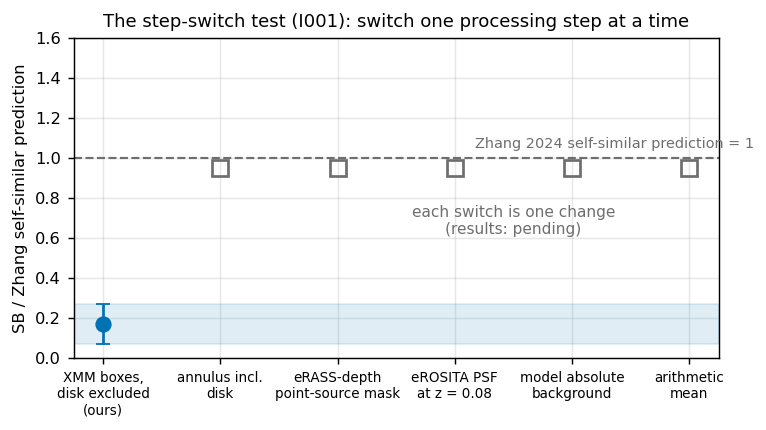
来源:cognition-os/insights/I001(方法对比表、候选原因、切换清单);cognition-os/02_CURRENT_QUESTION.md(成功判据)。Source: cognition-os/insights/I001 (method table, candidate causes, switch list); cognition-os/02_CURRENT_QUESTION.md (success criterion).
2. I004:零信号对照叠加2. I004: the null-signal control stack
已有的 XMM 控制(27–50 kpc 盘上方空白框:底 \approx 1%,95% \le 3.5%)不在 CCD1 中心——而每个目标都坐在 CCD1 中心。I004 的设计:用目标在视场中心但没有延展发射的指向场(暗场 + 点源场),按同样流程处理,直接测出那个位置的仪器"晕"。六步:Existing XMM controls (blank boxes 27–50 kpc above the disk: floor \(\approx 1\)%, 95% \(\le 3.5\)%) are not on the CCD1 centre — where every target sits. I004's design: take pointings whose target is at the field centre but has no extended emission (dark + point-source fields), process them identically, and measure the instrument-made "halo" at that position directly. Six steps:
- 池子:暗目标/空白场(仪器 + 天空)+ 点源目标(恒星、高红移 QSO:也含 PSF 翼与 OOT 条纹,匹配 AGN 主导的 ADAP 目标);排除延展结构附近(MCXC、XCLASS、eRASS 延展源)。Pool: dark targets/blank fields (instrument + sky) + point-source targets (stars, high-z QSOs — also PSF wings and out-of-time streaks, matching the AGN-dominated ADAP targets); exclude fields near extended structure (MCXC, XCLASS, eRASS extended sources).
- 按滤光片、模式、MOS1-CCD 损失历元、年份(QPB、SWCX)、干净曝光、SP 水平、银河前景 1:n 匹配。Match each science galaxy 1:n on filter, mode, MOS1-CCD-loss epoch, year (QPB, SWCX), clean exposure, SP level, Galactic foreground.
- 把区域按星系距离从 kpc 复制到角分,把侧向框旋转到同一探测器角。Copy the regions from kpc to arcmin at the galaxy's distance; rotate edge-on boxes to the same detector angle.
- 同一引擎(锁定的 esas_data_reduction)、掩模与 K 估计量。Same engine (the pinned esas_data_reduction), masks and K estimator.
- 与科学权重组合;重采样配对。Combine with the science weights; resample pairings.
- 按 MOS/pn、CCD1-only vs 跨 CCD、SP 水平、历元拆分,找原因。Split by MOS/pn, CCD1-only vs cross-CCD geometry, SP level, epoch to identify the cause.
试点的结果见"现状"页:pn \approx 0;MOS 偏置随场而变,原因开放。零场选择规则(历元、滤光片、曝光、NH、干净中心)与五个被淘汰的场见 null_pilot/selection/。The pilot's results are on the State page: pn \(\approx 0\); the MOS offset is field-dependent, cause open. The null selection rules (era, filter, exposure, NH, clean centre) and the five rejected fields are in null_pilot/selection/.
来源:cognition-os/insights/I004(设计六步);XMMproposal2026 I020(1%/3.5% 底);null_pilot/selection/SELECTION.md、SELECTION_v2.md。Source: cognition-os/insights/I004 (the six design steps); XMMproposal2026 I020 (1%/3.5% floor); null_pilot/selection/SELECTION.md, SELECTION_v2.md.
3. I007:普查式样本设计3. I007: the census-based sample design
样本设计不再凭经验,而是先"数一数档案里有什么"。覆盖规则:星系的整环要落在视场内(偏移 + 环角半径 \(\le\) 视场可用半径:ACIS-I 8.45′、ACIS-S 4.15′、XMM 14′);指向取目标坐标(不是 aimpoint),忽略 roll(约 \pm20% 的不确定度)。Sample design no longer guesses; it first counts what is in the archive. Coverage rule: the galaxy's full circle must fit inside the field (offset + annulus angular radius \(\le\) the usable field radius: ACIS-I 8.45′, ACIS-S 4.15′, XMM 14′); pointings use target coordinates (not the aimpoint), roll ignored (about \pm20% uncertainty).
| 样品Sample | N | Chandra 50/100/150/200/250 kpcChandra 50/100/150/200/250 kpc | XMMXMM |
|---|---|---|---|
| HECATE 15–50 Mpc,\(\log M_*\) 10.5–11.2(He & Li 式)HECATE 15–50 Mpc, \(\log M_*\) 10.5–11.2 (He & Li-like) | 1296 | 56/2/0/0/0 | 205/104/39/1/0 |
| HECATE 50–200 Mpc,\(\log M_*\) 10.5–11.0HECATE 50–200 Mpc, \(\log M_*\) 10.5–11.0 | 46983 | 945/635/411/219/119 | 3274/.../1748 |
| SDSS z 0.01–0.2,\(\log M_*\) 10.5–11.0(Zhang 式)SDSS z 0.01–0.2, \(\log M_*\) 10.5–11.0 (Zhang-like) | 251561 | 4969/4341/3753/3267/2823 | 15261/.../11992 |
| HyperLEDA Vrot 150–300 km/s,\(i \ge 45°\)HyperLEDA Vrot 150–300 km/s, \(i \ge 45°\) | 9566 | 203/101/49/23/13 | 570/447/361/271/217 |
四条解读(普查者的结论,Provisional):Chandra 适合 Zhang 式远距离样品;直接 Vrot 星表都在 z \lesssim 0.06,Vrot 选样的 Chandra 叠加在 150–250 kpc 只有几十颗;Vrot 假设用 eRASS1 公共数据检验;Chandra 的独特角色是点源深度。Four readings (the census-taker's conclusions, Provisional): Chandra suits the Zhang-like distant sample; direct-Vrot catalogues reach only z \(\lesssim 0.06\), so a Vrot-selected Chandra stack has only tens of galaxies at 150–250 kpc; the Vrot hypothesis is tested on eRASS1 public data; Chandra's distinctive role is point-source depth.
来源:cognition-os/insights/I007((b) 覆盖规则、(c) M* 选样、(d) Vrot 选样、(e) 解读)。Source: cognition-os/insights/I007 ((b) coverage rule, (c) M*-selected, (d) Vrot-selected, (e) reading).
4. 研究计划 P1–P4、S1–S24. The research plan P1–P4, S1–S2
| 编号ID | 任务Task | 喂给哪个决策Feeds which decision | 状态Status |
|---|---|---|---|
| P1 | Chandra S/N 预报(Zhang 式 SDSS M* 叠加:每历元 ACIS-I/S 软波段面积、粒子+天空背景、Zhang 轮廓 \(\to\) 每半径档 S/N vs N 与曝光)Chandra S/N forecast (Zhang-like SDSS M* stack: per-epoch ACIS-I/S soft-band area, particle + sky background, Zhang profile \(\to\) S/N per radial bin vs N and exposure) | 子问题 A 的 go/no-gogo/no-go for sub-question A | 待定Pending |
| P2 | eRASS1(DR1)"Vrot vs M*" 检验设计与 S/N 预报:HyperLEDA/ALFALFA/FASHI 取 Vrot,配平 M* 再按 Vrot 分eRASS1 (DR1) "Vrot vs M*" test design and S/N forecast: Vrot from HyperLEDA/ALFALFA/FASHI, M*-matched split by Vrot | 子问题 B 是否可裁决whether sub-question B is decidable | 待定Pending |
| P3 | 现实 Chandra 母样本:SDSS 中央星系经群表(Yang/Tinker),去星系团/群成员与亮目标场,真实 aimpoint + roll(CDA obscat/footprint)、ACIS-S 芯片组;重数 I007 (c)Realistic Chandra parent sample: SDSS centrals via a group catalogue (Yang/Tinker), cluster/group members and bright-target fields dropped, real aimpoint + roll (CDA obscat/footprint), ACIS-S chip set; recount I007 (c) | 现实筛选后的样本量sample size after realistic cuts | 待定Pending |
| P4 | 点源深度检验设计:Chandra 覆盖的星系里,eRASS1(与 eRASS:4)探测限与 Chandra 极限之间 CSC 2.1 点源的通量,在 10–50/50–150 kpc 环内,对 Zhang/He & Li 叠加 SBPoint-source-depth test design: for Chandra-covered galaxies, the flux in CSC 2.1 point sources between the eRASS1 (and eRASS:4) detection limit and the Chandra limit, inside 10–50/50–150 kpc annuli, vs the Zhang/He & Li stacked SB | I001 步骤 2I001 step 2 | 待定Pending |
| S1 | z 0.02–0.2 可用的 Vrot 星表检索(DESI PV Tully–Fisher DR1/DR2、WALLABY、FASHI/CRAFTS、MaNGA/SAMI、SDSS 代理)Search for Vrot catalogues usable for stacking at z 0.02–0.2 (DESI PV Tully–Fisher DR1/DR2, WALLABY, FASHI/CRAFTS, MaNGA/SAMI, SDSS proxies) | P2 的输入inputs to P2 | 待定Pending |
| S2 | 文献:Vrot(或 Vc、晕质量)vs M* 作为热 CGM 预测因子;早期 Chandra/ROSAT/XMM 叠加;Zhang+2024 与 He & Li 2026 的确切选样与是否公开Literature: Vrot (or Vc, halo mass) vs M* as predictor of hot-CGM \(L_X\); earlier Chandra/ROSAT/XMM stacks; the exact Zhang+2024 and He & Li 2026 selections and whether their lists are public | P2 与选样P2 and the selection | 待定Pending |
来源:cognition-os/RESEARCH_PLAN.md;cognition-os/SEARCH_QUEUE.md。Source: cognition-os/RESEARCH_PLAN.md; cognition-os/SEARCH_QUEUE.md.