为什么做这个项目Why this project exists
1. 热 CGM 为什么重要1. Why the hot CGM matters
宇宙学把星系形成算得很清楚:恒星里的重子(baryon,普通物质)只占星系应当拥有的很小一部分。比如银河系这样 \(10^{12} M_\odot\) 量级暗物质晕(dark-matter halo)的星系,恒星质量约 \(6 \times 10^{10} M_\odot\),其余的大部分重子应当在星系周围的热气体里——星系周介质(circumgalactic medium, CGM),温度 \(10^{6}\)–\(10^{7}\) K,在 X 射线波段发光。CGM 是星系"呼吸"的地方:恒星形成吹出的风、活动星系核(AGN)的反馈(feedback)把金属与能量送进去,新的气体又从里面冷凝下来。所以测准热 CGM 的多少,等于直接测星系反馈的账本。Cosmology is clear about galaxy formation: the baryons in stars are only a small fraction of what a galaxy should own. For a Milky-Way-like galaxy in a \(\sim 10^{12} M_\odot\) dark-matter halo, the stellar mass is about \(6 \times 10^{10} M_\odot\); most of the remaining baryons should be in hot gas around the galaxy — the circumgalactic medium (CGM), at \(10^{6}\)–\(10^{7}\) K, glowing in X-rays. The CGM is where a galaxy "breathes": winds from star formation and AGN feedback pump metals and energy into it, and new gas condenses out of it. Measuring the hot CGM accurately is measuring the ledger of galactic feedback.
举一个数:Zhang et al. 2026 从 eROSITA 叠加推出银河系质量星系晕里的热气体质量为 \(0.8\)–\(3.5 \times 10^{11} M_\odot\)。这已经与恒星质量同量级——所以"晕里有多少热气体"直接决定重子预算是否平衡。One number: Zhang et al. 2026 infer \(0.8\)–\(3.5 \times 10^{11} M_\odot\) of hot gas in Milky-Way-mass halos from their eROSITA stack. That is already the same order as the stellar mass — so "how much hot gas is in the halo" decides whether the baryon budget balances at all.
来源:热气体质量范围来自 XMMproposal2026 cognition-os/insights/I010_literature_context.md 所引 Zhang+2026(arXiv:2511.17313,热气体 0.8–3.5e11 Msun);恒星质量与晕质量是教科书量级。Source: the hot-gas mass range is from Zhang+2026 (arXiv:2511.17313, hot gas 0.8–3.5e11 Msun) as cited in XMMproposal2026 cognition-os/insights/I010_literature_context.md; the stellar and halo masses are textbook scales.
2. eROSITA 叠加发现了什么2. What the eROSITA stacks found
eROSITA 是搭在 Spektr-RG 卫星上的 X 射线巡天望远镜,对全天扫描(eRASS1 是第一圈)。单个银河系质量星系的 CGM 太暗,巡天数据里看不见;但把成千上万颗星系的图像叠加(stacking)起来,信号按 \(N\) 增长、噪声按 \(\sqrt{N}\) 下降,就能测出平均轮廓。两篇文章是这个项目的出发点:eROSITA is the X-ray survey telescope aboard Spektr-RG, scanning the whole sky (eRASS1 is the first pass). The CGM of a single Milky-Way-mass galaxy is too faint to see in survey data; but stacking thousands of galaxy images grows the signal as \(N\) while the noise falls as \(\sqrt{N}\), and the mean profile becomes measurable. Two papers are this project's starting point:
- Zhang et al. 2024(两篇):按恒星质量分档叠加 SDSS 中央星系。银河系质量档(30 825 颗,中位红移 0.08)测到 CGM 发射到约 50 kpc 以外;积分光度的标度 \(L_X \propto M_*^{2.4}\)。内区轮廓是 PSF 去卷积后的模型,不是直接测量。Zhang et al. 2024 (two papers): stacked SDSS central galaxies in stellar-mass bins. The Milky-Way-mass bin (30 825 galaxies, median redshift 0.08) shows CGM emission beyond \(\sim 50\) kpc; integrated luminosity scales as \(L_X \propto M_*^{2.4}\). The inner profile is a PSF-deconvolved model, not a direct measurement.
- He & Li 2026:eRASS1 里 474 颗 L* 星系(15–50 Mpc,大部分恒星形成中),\(7.4\sigma\) 检测到 \(\ge 50\) kpc,\beta = 0.52,轮廓比 Zhang 的"更低更陡"。他们还做了方位角检验:114 颗倾角大的星系绕盘旋转后,主/次轴方向没有差别(10–50 kpc)——这削弱了"盘光混入"的解释,但没有排除(信噪比有限)。He & Li 2026: 474 L* galaxies from eRASS1 (15–50 Mpc, mostly star-forming), \(7.4\sigma\) detection to \(\ge 50\) kpc, \beta = 0.52, with a profile "lower and steeper" than Zhang's SDSS stack. Their azimuthal test — 114 inclined galaxies rotated about the disk, no major/minor-axis difference at 10–50 kpc — weakens the "disk light mixed in" explanation but does not exclude it (limited S/N).
来源:cognition-os/00_AI_BRIEFING.md;XMMproposal2026 cognition-os/insights/I010_literature_context.md;I001 的方法对比表(Zhang 30 825、He & Li 474、\beta 0.52、7.4\sigma)。Source: cognition-os/00_AI_BRIEFING.md; XMMproposal2026 cognition-os/insights/I010_literature_context.md; the method-comparison table of I001 (Zhang 30 825, He & Li 474, \beta 0.52, 7.4\sigma).
3. 我们的分辨测量为什么不同意3. Why our resolved measurements disagree
AO-26 提案工作的对象是几颗邻近的侧向(edge-on)旋涡星系,用 XMM-Newton 逐颗分辨测量:源区放在离盘 10–20 kpc 的"高"处(避开盘与风),背景用同一侧的 8–11′ 局部框。四颗星系的反方差组合给出 SB/prediction \(0.17 \pm 0.10\)(Vc 标度)——比 Zhang 自相似预测低约 5 倍。大多数 L* 星系的 \(L_X\) 上限(\(10^{38}\)–\(1.4 \times 10^{39}\) erg/s)也在叠加档(\(\approx 1\)–\(1.5 \times 10^{39}\))之下。已测到的巨大星系晕(CGM-MASS、M104、NGC 5746)坐在 Zhang 的 M31 档附近。The AO-26 proposal work targets a few nearby edge-on spirals measured one at a time with XMM-Newton: the source region sits in the "heights" 10–20 kpc above the disk (avoiding the disk and winds), and the background is the same side's local 8–11′ box. The inverse-variance combination of four galaxies gives SB/prediction \(0.17 \pm 0.10\) (Vc scaling) — about five times below the Zhang self-similar prediction. Most L* \(L_X\) upper limits (\(10^{38}\)–\(1.4 \times 10^{39}\) erg/s) are also below the stacked bins (\(\approx 1\)–\(1.5 \times 10^{39}\)). The detected massive halos (CGM-MASS, M104, NGC 5746) sit near Zhang's M31 bin.
为什么这重要:如果叠加是"真"的,那我们漏掉了 5 倍的辐射;如果我们的测量是"对"的,那 eROSITA 叠加被某种方法学偏差(盘光、PSF 去卷积、点源掩模深度、背景定义)系统性地推高了。两种可能对 CGM 的物理结论完全不同——所以必须分解,不能二选一地猜。Why it matters: if the stack is right we are missing a factor of five in flux; if our measurements are right the eROSITA stack is systematically inflated by some methodological bias (disk light, PSF deconvolution, point-source mask depth, background definition). The two possibilities give very different physical conclusions about the CGM — so the tension must be decomposed, not guessed between.
来源:cognition-os/00_AI_BRIEFING.md;cognition-os/03_TRUST_TABLE.md T02;XMMproposal2026 cognition-os/insights/I030_lx_vs_mass_detected_massive_vs_lstar.md。Source: cognition-os/00_AI_BRIEFING.md; cognition-os/03_TRUST_TABLE.md T02; XMMproposal2026 cognition-os/insights/I030_lx_vs_mass_detected_massive_vs_lstar.md.
4. Chandra 与 XMM 档案为什么能帮忙4. Why the Chandra and XMM archives can help
要分解矛盾,需要"同一批星系、两种方法"。XMM 档案提供深度(几十至几百 ks 的指向观测),Chandra 档案提供分辨率(在轴半能量宽度约 0.8″,比 XMM 的 15″ 细 20 倍)。普查(I007)说清了它们各自的用场:Decomposing the tension needs "the same galaxies, two methods". The XMM archive provides depth (tens to hundreds of ks per pointing); the Chandra archive provides resolution (on-axis half-energy width \(\approx 0.8\)″, 20\times finer than XMM's 15″). The census (I007) says where each is useful:
- Chandra 适合 Zhang 式远距离 M* 选样:几千颗 SDSS 星系的整个 50–250 kpc 环都能放进一个 ACIS 视场里(因为远,环在天空上只有几角分);点源可以剔到比 eRASS 深几个量级的极限——这是检验"未分辨点源贡献了多少叠加光"的唯一途径。Chandra suits the Zhang-like distant M* sample: for thousands of SDSS galaxies the whole 50–250 kpc annulus fits in one ACIS field (at those distances the annulus is only a few arcmin); point sources can be removed to a limit orders of magnitude deeper than eRASS — the only route to testing how much unresolved point-source light feeds the stack.
- XMM 适合需要面积的场:30′ 视场与更深的单场曝光;对 Vrot 选样(星表都在 z \lesssim 0.06)XMM 能覆盖几百颗,Chandra 只有几十颗。XMM suits fields that need area: a 30′ field and deeper single pointings; for a Vrot-selected sample (catalogues reach only z \(\lesssim 0.06\)) XMM covers hundreds of galaxies, Chandra only tens.
- eRASS1 公共数据适合 Vrot vs M* 的第一个检验:不用新观测,按 Vrot 与 M* 分别选样、配平质量再叠加对比即可(P2 在设计)。eRASS1 public data suits the first Vrot-vs-M* test: no new observations needed — select by Vrot and by M*, mass-match, and compare the stacks (P2 is designing it).
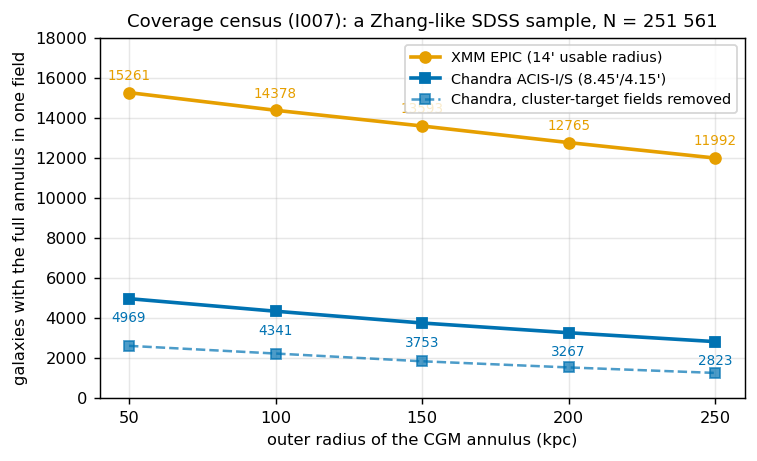
来源:cognition-os/insights/I007((a) 分辨元、(c) M* 选样、(d) Vrot 选样、(e) 解读);图:handbook/scripts/make_figures.py(fig_census.png),XMM 计数由 census_xmm_counts.py 于 2026-10-21 对普查数据副本重跑得到(端点 15261/11992 与 I007 (c) 一致)。Source: cognition-os/insights/I007 ((a) resolution elements, (c) M*-selected, (d) Vrot-selected, (e) reading); figure: handbook/scripts/make_figures.py (fig_census.png), with the XMM counts re-run on a copy of the census data by census_xmm_counts.py on 2026-10-21 (the endpoints 15261/11992 match I007 (c)).