物理与统计:从零开始The physics and statistics from zero
- 热气体发射与表面亮度Hot-gas emission and surface brightness
- 角大小与距离Angular size and distance
- PSF 与每场分辨元PSF and resolution elements per field
- 背景的成分The background components
- 叠加与 S/N 如何随 N 增长Stacking and how S/N grows with N
- 点源掩模深度Point-source masking depth
- 零检验(null test)Null tests
- 为什么背景必须差分Why the background must be differential
1. 热气体发射与表面亮度1. Hot-gas emission and surface brightness
温度 \(10^{6}\) K 量级的气体主要发出软 X 射线(0.5–2 keV),谱形近似 APEC 热等离子体模型,由温度 \(T\) 与金属丰度决定。我们测的不是总光度,而是表面亮度(surface brightness, SB):单位投影面积上的光度,单位 erg s\(^{-1}\) kpc\(^{-2}\)。表面亮度不随距离变暗(宇宙学近似下),这是它能跨距离比较的原因。Gas at \(10^{6}\) K radiates mainly in soft X-rays (0.5–2 keV), with a spectrum close to an APEC thermal-plasma model set by temperature \(T\) and metal abundance. What we measure is not the total luminosity but the surface brightness (SB): luminosity per unit projected area, in erg s\(^{-1}\) kpc\(^{-2}\). Surface brightness does not dim with distance (to cosmological approximation), which is why it can be compared across distances.
算一个数。Zhang 银河系质量档在 15 kpc 处的自相似预测约 \(1.05 \times 10^{36}\) erg s\(^{-1}\) kpc\(^{-2}\)(0.5–2 keV)。我们的拟合用 APEC 范数(kT 0.3 keV)作幅度;在 NGC 5746(29.4 Mpc)上,\(K = 1\)(即 \(1 \times 10^{-6}\) norm arcmin\(^{-2}\))乘换算因子 \(8.757 \times 10^{35}\) 再乘环面积就是 erg/s。所以 \(K\) 是"预测的倍数",不是绝对亮度。One worked number. The Zhang self-similar prediction for the MW-mass bin at 15 kpc is \(\approx 1.05 \times 10^{36}\) erg s\(^{-1}\) kpc\(^{-2}\) (0.5–2 keV). Our fits use the APEC norm (kT 0.3 keV) as the amplitude; at NGC 5746 (29.4 Mpc), \(K = 1\) (i.e. \(1 \times 10^{-6}\) norm arcmin\(^{-2}\)) times the conversion \(8.757 \times 10^{35}\) times the annulus area gives erg/s. So \(K\) is "multiples of the prediction", not an absolute brightness.
来源:XMMproposal2026 cognition-os/insights/I003_erosita_method_on_xmm_archive.md(Zhang MW SB at 15 kpc 1.05e36);XMMproposal2026 cognition-os/insights/I023_central_ccd_excess_5746_3079.md(NGC 5746 K \times 8.757e35 \times 环面积,kT 0.3)。Source: XMMproposal2026 cognition-os/insights/I003_erosita_method_on_xmm_archive.md (Zhang MW SB at 15 kpc 1.05e36); XMMproposal2026 cognition-os/insights/I023_central_ccd_excess_5746_3079.md (NGC 5746 K \times 8.757e35 \times annulus area, kT 0.3).
2. 角大小与距离2. Angular size and distance
天空上的角大小与物理大小的关系由角直径距离决定。小角近似下:The angular size on the sky and the physical size are related by the angular-diameter distance. At small angles:
\[ \theta({\rm arcmin}) = \frac{R({\rm kpc})}{D({\rm Mpc}) \times 0.2909} \]
\[ \theta({\rm arcmin}) = \frac{R({\rm kpc})}{D({\rm Mpc}) \times 0.2909} \]
算一个数。He & Li 的星系在 15 Mpc:10 kpc 的环内缘张角 \(10/(15 \times 0.2909) \approx 2.3′\),50 kpc 的外缘约 11.5′——刚好在 XMM 30′ 视场里。Zhang 的星系在 108 Mpc(中位红移 0.08):50 kpc 只有 1.6′,250 kpc 也只有 8′。同一物理半径,远星系的环在天空上小得多,所以远星系能把整个 50–250 kpc 环放进 Chandra 的小视场里,而近星系做不到。One worked number. A He & Li galaxy at 15 Mpc: the inner edge of a 10 kpc annulus subtends \(10/(15 \times 0.2909) \approx 2.3′\), and the 50 kpc outer edge about 11.5′ — just inside XMM's 30′ field. A Zhang galaxy at 108 Mpc (median redshift 0.08): 50 kpc is only 1.6′, and 250 kpc only 8′. The same physical radius is far smaller on the sky for distant galaxies, so a distant galaxy can fit its whole 50–250 kpc annulus in Chandra's small field while a nearby one cannot.
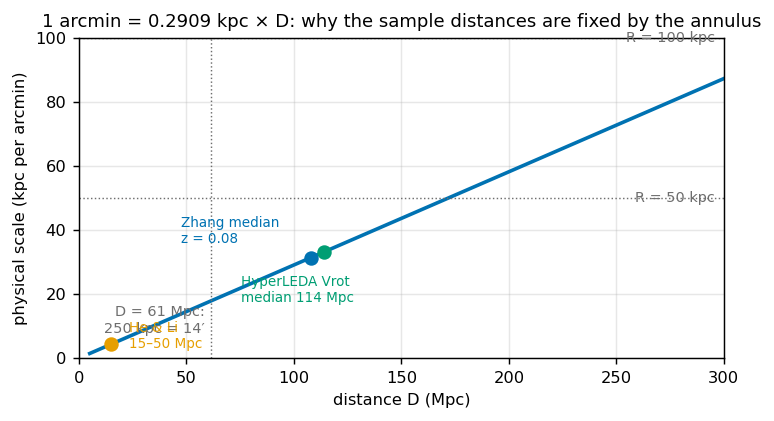
来源:系数 0.2909 kpc/arcmin/Mpc 来自 XMMproposal2026 adap_sample_comparison/kpc_fov_selection.py 的距离窗口公式;中位红移 0.08 与 108 Mpc 来自 I001 方法对比表(Zhang 中位 z 0.08)与普查(中位 D 114 Mpc,HyperLEDA Vrot 样品)。Source: the coefficient 0.2909 kpc/arcmin/Mpc is from the distance-window formula of XMMproposal2026 adap_sample_comparison/kpc_fov_selection.py; the median redshift 0.08 and 108 Mpc are from the I001 method table (Zhang median z 0.08) and the census (median D 114 Mpc for the HyperLEDA Vrot sample).
3. PSF 与每场分辨元3. PSF and resolution elements per field
望远镜不是把天空上的一个点拍成一个点,而是拍成一团光斑——点扩散函数(point-spread function, PSF)。常用宽度是半能量宽度(half-energy width, HEW):包含一半光子的圆的直径。eROSITA 巡天平均 HEW 约 26″,XMM MOS/pn 约 15″/13.5″,Chandra 在轴约 0.8″。对 CGM 测量,PSF 决定"多小的结构看不见":Zhang 的星系(z 0.08)里,26″ 的 HEW 对应 47 kpc——整个内区 \(\le 50\) kpc 都在一个分辨元里,所以他们的内区轮廓是 PSF 去卷积后的模型。我们的 XMM 指向在 10–30 Mpc,15″ 只有 1–4 kpc——所以能分开盘与晕。A telescope does not image a point on the sky as a point but as a blob — the point-spread function (PSF). A common width is the half-energy width (HEW): the diameter of the circle holding half the photons. eROSITA's survey-average HEW is \(\approx 26\)″, XMM MOS/pn \(\approx 15\)″/13.5″, Chandra on-axis \(\approx 0.8\)″. For CGM work the PSF sets "how small a structure is invisible": in a Zhang galaxy (z 0.08), a 26″ HEW spans 47 kpc — the whole inner \(\le 50\) kpc is one resolution element, so their inner profile is a PSF-deconvolved model. Our XMM pointings at 10–30 Mpc have 15″ = 1–4 kpc — disk and halo can be separated.
算一个数。把视场面积除以 HEW 直径的圆面积,就得到"分辨元数":eROSITA 一个 1.03° 圆场约 \(1.6 \times 10^{4}\) 个;XMM 30′ 场约 \(1.1 \times 10^{4}\) 个;Chandra ACIS-I 16.9′ 方场约 \(2.0 \times 10^{5}\) 个(在轴)。Chandra 的分辨元多 20 倍,正是它做点源剔除的优势。One worked number. Dividing the field area by the area of a HEW-diameter circle gives the number of "resolution elements": eROSITA's 1.03° circular field holds \(\approx 1.6 \times 10^{4}\); XMM's 30′ field \(\approx 1.1 \times 10^{4}\); Chandra ACIS-I's 16.9′ square \(\approx 2.0 \times 10^{5}\) (on-axis). Chandra's 20\times more elements is exactly its advantage for point-source removal.
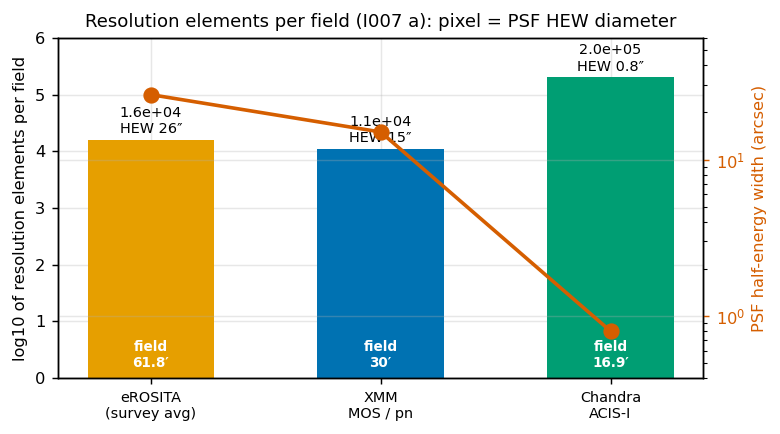
来源:cognition-os/insights/I007 (a)(HEW 26″/15″/13.5″/0.8″,分辨元 1.6e4/1.1–1.4e4/2.0e5,视场 1.03°/30′/16.9′);I001 方法对比表(PSF in kpc:Zhang 41–47 kpc,He & Li 2–7 kpc,我们 1–4 kpc)。Source: cognition-os/insights/I007 (a) (HEW 26″/15″/13.5″/0.8″, elements 1.6e4/1.1–1.4e4/2.0e5, fields 1.03°/30′/16.9′); the I001 method table (PSF in kpc: Zhang 41–47 kpc, He & Li 2–7 kpc, ours 1–4 kpc).
4. 背景的成分4. The background components
X 射线探测器记录的不只是天体。一场 XMM 观测里,计数率大致由这些成分叠成:An X-ray detector records more than the target. In one XMM observation the count rate is a stack of roughly these components:
| 成分Component | 是什么What it is | 时间行为Time behaviour |
|---|---|---|
| 天体光子Celestial photons | 银河系前景(本地热气泡、银河晕)、宇宙 X 射线背景(cosmic X-ray background, CXB)、目标本身的 CGMGalactic foreground (local hot bubble, Milky-Way halo), the cosmic X-ray background (CXB), and the target's own CGM | 单场内基本稳定(SWCX 例外)roughly stable within one observation (SWCX excepted) |
| 静止粒子背景Quiescent particle background (QPB) | 高能粒子在 CCD 里造成的计数,用掩角事件的"背景谱"(back.pi)建模counts from energetic particles hitting the CCD, modelled with the corner-events "background spectrum" (back.pi) | 随时间漂移drifts with time |
| 软质子Soft protons (SP) | 被磁层聚焦的低能质子;有耀斑,也有稳态残余;谱形是幂律low-energy protons focused by the magnetosphere; they flare and also leave a steady residual; power-law spectrum | 强时变strongly time-variable |
| 仪器荧光线Instrumental fluorescence lines | Al-K 1.49 keV、Si-K 1.75 keV 等仪器材料线instrument-material lines such as Al-K 1.49 keV and Si-K 1.75 keV | 基本稳定roughly stable |
算一个数。在零场试点的参照框里,0.5–2 keV 的计数只有 9–30% 是天体(天空)光子,QPB 约 30%,仪器线占 40–50%——天空只是小头,所以天空模型与粒子模型之间的任何交换都会直接进入源区的"超额"。One worked number. In the null pilot's reference boxes, only 9–30% of the 0.5–2 keV counts are celestial (sky) photons; QPB is \(\sim 30\)%, instrumental lines 40–50% — the sky is the minority, so any trade between the sky model and the particle model lands directly in the source region's "excess".
来源:cognition-os/insights/I006 (l)(参照框成分分解 9–30% 天空、QPB 约 30%、线 40–50%);XMMproposal2026 I020/I021(控制框底 1%,95% 上限 3.5%)。Source: cognition-os/insights/I006 (l) (reference-box decomposition 9–30% sky, QPB \(\sim 30\)%, lines 40–50%); XMMproposal2026 I020/I021 (control-box floor \(\approx 1\)%, 95% upper 3.5%).
5. 叠加与 S/N 如何随 N 增长5. Stacking and how S/N grows with N
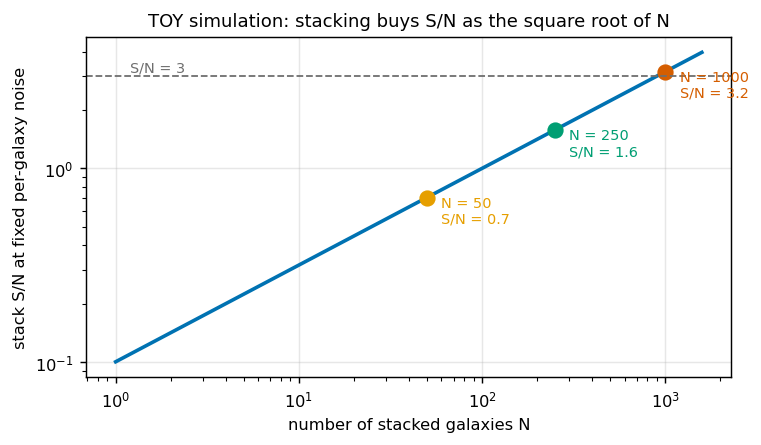
叠加(stacking)把 \(N\) 颗星系的同一半径区域的表面亮度或计数加起来。如果每颗的噪声是独立的(随机背景涨落),信号按 \(N\) 线性增长,噪声按 \(\sqrt{N}\) 增长,所以Stacking adds the surface brightness or counts of the same radial region for \(N\) galaxies. If each galaxy's noise is independent (random background fluctuation), the signal grows as \(N\) and the noise as \(\sqrt{N}\), so
\[ {\rm S/N} = \frac{N\,S}{\sqrt{N}\,\sigma} = \frac{\sqrt{N}\,S}{\sigma} \]
\[ {\rm S/N} = \frac{N\,S}{\sqrt{N}\,\sigma} = \frac{\sqrt{N}\,S}{\sigma} \]
算一个数。假设单颗星系的 CGM 信号只给出 S/N = 0.10(很暗):叠 50 颗得 S/N 0.7,叠 250 颗得 1.6,叠 1000 颗得 3.2。这就是为什么 eROSITA 要叠 30 000 颗才敢报 10–50 kpc 的轮廓。但注意:叠加只压低随机噪声,不压低系统误差——如果每颗都带同一个方向偏置(例如点源掩模太浅漏掉的同一种源),叠加后它按 \(N\) 增长,S/N 看起来更好,实际更糟。One worked number. Suppose one galaxy's CGM signal gives S/N = 0.10 (very faint): 50 galaxies give 0.7, 250 give 1.6, 1000 give 3.2. That is why eROSITA stacked 30 000 galaxies before quoting a 10–50 kpc profile. But note: stacking reduces random noise only, never systematics — if every galaxy carries the same one-directional bias (say the same kind of source missed by a too-shallow point-source mask), it grows as \(N\) in the stack: the S/N looks better while the answer is worse.
6. 点源掩模深度6. Point-source masking depth
叠加前要把场里的点源(背景 AGN、X 射线双星)掩掉——在图像上挖洞。但"挖到多深"各方法差别巨大:Zhang 只掩 eRASS:4 表里的源(对应 \(L_X \gtrsim 10^{41}\) erg/s 的天体),He & Li 掩到完备流量 \(4.5 \times 10^{-14}\) erg cm\(^{-2}\) s\(^{-1}\)(\(L_X \approx 1.2 \times 10^{39}\)–\(1.3 \times 10^{40}\) erg/s),我们的 XMM 指向掩到 \(10^{37}\)–\(3 \times 10^{38}\) erg/s,Chandra 档案能到更深。掩模浅一层,漏掉的点源光就被算进"CGM"里。Before stacking, point sources (background AGN, X-ray binaries) are masked — cut holes in the image. But "how deep" differs enormously between methods: Zhang mask only eRASS:4 catalogue sources (\(L_X \gtrsim 10^{41}\) erg/s objects), He & Li mask to a completeness flux of \(4.5 \times 10^{-14}\) erg cm\(^{-2}\) s\(^{-1}\) (\(L_X \approx 1.2 \times 10^{39}\)–\(1.3 \times 10^{40}\) erg/s), our XMM pointings reach \(10^{37}\)–\(3 \times 10^{38}\) erg/s, and the Chandra archive goes deeper still. One level shallower, and the missed point-source light is counted as "CGM".
算一个数。三种掩模深度跨越 \(> 1000\) 倍的光度。I001 估计:银河系质量旋涡盘的 LMXB+HMXB+热 ISM 约 \(4.5\)–\(6 \times 10^{39}\) erg/s(0.5–2 keV),其中 9–35% 投影到 10 kpc 以外——即 \(0.4\)–\(2 \times 10^{39}\) erg/s,与叠加的 10–30 kpc 档(\(1.8\)–\(2.5 \times 10^{39}\))同量级。所以"点源深度"不是细节,是主要嫌疑之一。One worked number. The three mask depths span \(> 1000\times\) in luminosity. I001 estimates: the LMXB+HMXB+hot ISM of a MW-mass spiral disk is \(\approx 4.5\)–\(6 \times 10^{39}\) erg/s (0.5–2 keV), of which 9–35% projects beyond 10 kpc — i.e. \(0.4\)–\(2 \times 10^{39}\) erg/s, the same order as the stacked 10–30 kpc bins (\(1.8\)–\(2.5 \times 10^{39}\)). So "mask depth" is not a detail; it is a leading suspect.
来源:I001 方法对比表(掩模深度行)与候选原因 1、4(盘光 4.5–6e39、9–35% 投影、叠加档 1.8–2.5e39)。Source: the I001 method table (the point-source mask row) and candidate causes 1 and 4 (disk light 4.5–6e39, 9–35% projected, stacked bins 1.8–2.5e39).
7. 零检验(null test)7. Null tests
零检验是"假装有信号,看仪器会不会无中生有"。做法:找一些没有延展发射的观测(暗场、点源场),把目标放在视场中心、但目标本身没有 CGM;然后用与科学数据完全相同的流程(同一区域布局、同一拟合、同一估计量)处理。如果流程有偏置,零场会显示出来;科学值减去零值,偏置就消掉了。A null test asks: "if there were no signal, would the pipeline invent one?" Take observations with no extended emission (dark fields, point-source fields) — the target is at the field centre but has no CGM — and process them identically to the science data (same region layout, same fit, same estimator). If the pipeline is biased, the null shows it; science minus null removes the bias.
算一个数。本项目的零场试点:九个零场按 NGC 5746/3079/4565/3628 的探测器位置旋转区域后拟合。pn 六场平均 \(-0.02 \pm 0.06\)(零);MOS 九场 \(-0.19 \pm 0.06\)——不为零,且随场而变(常规场 \(-0.37 \pm 0.08\),硬超额场 \(+0.06 \pm 0.10)\)。NGC 5746 科学值减去它自己的两个零场:MOS \(+0.98 \pm 0.18\)、pn \(+0.87 \pm 0.14\)——超额仍在,所以是真的发射或观测特有的污染,不是探测器位置的伪影。One worked number. This project's null pilot: nine null fields with regions rotated to the NGC 5746/3079/4565/3628 detector positions, fitted the same way. The six pn nulls average \(-0.02 \pm 0.06\) (zero); the nine MOS nulls \(-0.19 \pm 0.06\) — not zero, and field-dependent (normal fields \(-0.37 \pm 0.08\), hard-excess fields \(+0.06 \pm 0.10\)). NGC 5746 science minus its own two nulls: MOS \(+0.98 \pm 0.18\), pn \(+0.87 \pm 0.14\) — the excess survives, so it is real emission or an observation-specific contaminant, not a detector-position artefact.
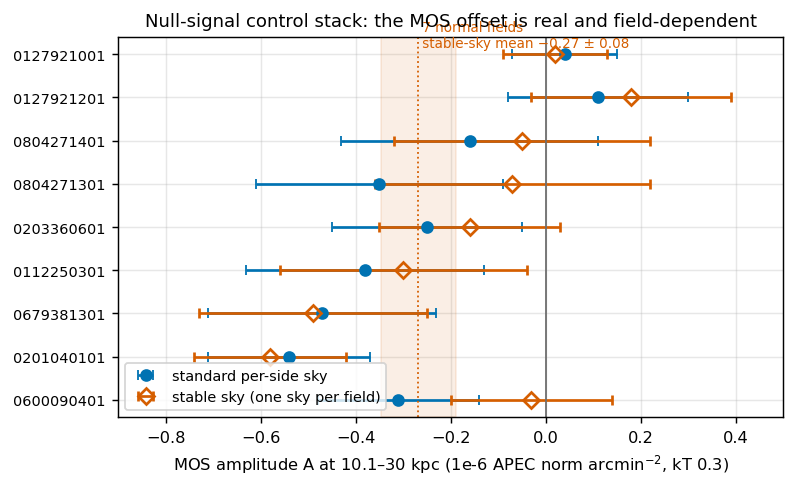
来源:cognition-os/insights/I006(证据表与 (e),(m));null_pilot/fits/results_claude/stablesky/ 与 results_codexnim/(数字);图:make_figures.py(fig_nulls.png)。Source: cognition-os/insights/I006 (evidence table and (e),(m)); null_pilot/fits/results_claude/stablesky/ and results_codexnim/ (numbers); figure: make_figures.py (fig_nulls.png).
8. 为什么背景必须差分8. Why the background must be differential
近星系(10–12 Mpc)的晕延伸到 XMM 视场边缘之外:30′ 视场只到 40–45 kpc,而 Zhang 轮廓在那里还有 \(1.3\)–\(1.5 \times 10^{35}\) erg s\(^{-1}\) kpc\(^{-2}\)。所以"视场内的背景框"本身含着晕——直接减掉它,等于把信号也减掉了。解决办法是差分估计量:拟合一个叠加尺度因子 \(A\),让模型在源区的平均值减去模型在背景区的平均值去对数据;预测也必须是"源区均值 − 背景区均值"。For nearby galaxies (10–12 Mpc) the halo extends beyond the XMM field: the 30′ field reaches only 40–45 kpc, where the Zhang profile is still \(1.3\)–\(1.5 \times 10^{35}\) erg s\(^{-1}\) kpc\(^{-2}\). So the in-field background box already contains halo — subtracting it outright subtracts the signal too. The fix is a differential estimator: fit a stack scale factor \(A\) so that the model's source-region mean minus its background-region mean matches the data; predictions must also be "source mean − background mean".
算一个数。kpc-在-场内 设计算过自减比例(背景环平均 SB \(\div\) 源环平均 SB):信号 10–50 | 背景 50–100 kpc 时,Zhang MW 轮廓给 0.23,M31/2M31 给 0.33–0.35,He & Li 给 0.10–0.14。也就是说,"局部背景"会吞掉 10–35% 的信号——预测若不做差分修正,测出的"晕"就天生偏小。One worked number. The kpc-in-field design computed self-subtraction ratios (background-annulus mean SB \(\div\) source-annulus mean SB): for signal 10–50 | background 50–100 kpc, the Zhang MW profile gives 0.23, M31/2M31 give 0.33–0.35, He & Li 0.10–0.14. In other words a "local background" swallows 10–35% of the signal — a prediction that is not corrected differentially makes the measured "halo" too small from birth.
来源:XMMproposal2026 cognition-os/insights/I005_differential_measurement.md(视场只到 40–45 kpc、轮廓仍 1.3–1.5e35);I003 与 adap_sample_comparison/kpc_fov_selection.txt(自减比例 0.23 / 0.33–0.35 / 0.10–0.14)。Source: XMMproposal2026 cognition-os/insights/I005_differential_measurement.md (the field reaches only 40–45 kpc, profile still 1.3–1.5e35); I003 and adap_sample_comparison/kpc_fov_selection.txt (self-subtraction 0.23 / 0.33–0.35 / 0.10–0.14).